
ONLINE COURSE
Sustainability:
Why enroll in this course?

Gain all-encompassing insights into sustainable business practices applicable to professionals in every industry.

Become a catalyst for change within your organization by using qualitative and quantitative information to make sustainable business decisions.

Create pragmatic strategies and establish policies that are applicable across multiple sectors to improve sustainability.

Engage in two live sessions with MIT instructors, and up to eight live sessions with learning facilitators, industry experts, and peers.

Networking opportunities establish professional connections with industry experts and your cohort.

Access to rich supplementary resources provides additional materials and content for a more thorough educational journey.
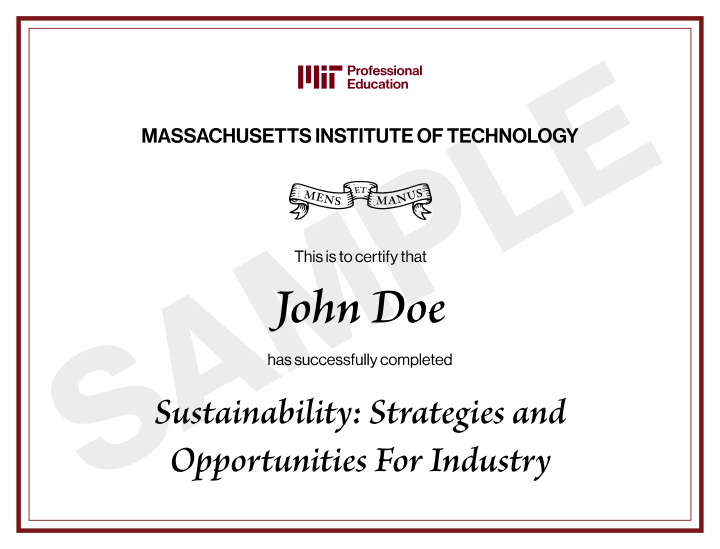
Certificate
All the participants who successfully complete their program will receive an MIT Professional Education Certificate of Completion, as well as Continuing Education Units (CEUs)*.
To obtain CEUs, complete the accreditation confirmation, which is available at the end of the course. CEUs are calculated for each course based on the number of learning hours.
*The Continuing Education Unit (CEU) is defined as 10 contact hours of ongoing learning to indicate the amount of time they have devoted to a non-credit/non-degree professional development program. To understand whether or not these CEUs may be applied toward professional certification, licensing requirements, or other required training or continuing education hours, please consult your training department or licensing authority directly.
Course outline
Sustainability
The Concept of Sustainability
Tragedy of the Commons
Shared Use of Common Resources: A Variety of Approaches
Industrialization And Global Population
Principles of Sustainability
IPAT And Ecological Footprint
Materials and Energy I
Renewable and Nonrenewable Resources
Life Cycle Assessment - Using Open LCA software
Measuring Sustainability
Material Flows: Water
Material Flows: Food
Materials and Energy II
Material flows
Classifying Materials
Waste
Energy
Environmental Consequences of our Expanding Energy Needs
Energy System Transition
Sustainable Products and Consumption
Circular Economy
Dematerialization
Industrial Ecology
Sustainable Business Strategies
Cities, Resources, and the Global Economy
Cities and Resources: Historical Perspective
Cities and Resources: Urban Economics
Urban Population
Urban Metabolism
Urban Resources Consumption
Tools for Addressing Urban Sustainability
Urban Climate Risks
Ethics of Sustainability
Ethics of Sustainability
Ethical Traditions
Forms of Justice
Ethical Production and Consumption
Corporate Misconduct and Moving Forward
Global Opportunities in the Anthropocene
The Nine Planetary Boundaries
Corporate Sustainability
Climate Change and Rapid Decarbonization
Mitigation of Greenhouse Gas Emissions
Climate Solutions
The Anthropocene
Sustainable Development and the Grand Transition
United Nations Sustainable Development Goals
A Closer Look at Four SDGs
International Agreements and Environmental Challenges
Mercury Pollution
Loss of Biological Diversity
Risks and Rewards of the Grand Transition
Who is this online course for?
Corporate and strategic decision-makers determined to make an impact in their organizations.
C-suite, managers, and other high-level professionals from any sector who oversee teams and are interested in implementing new strategies to enhance their business’s sustainability.
Technical experts with a strong interest in sustainable business operations.
Professionals who want to implement sustainable practices in their industry.
Data analysts, scientists, and engineers interested in achieving data-driven sustainable outcomes.
Instructor
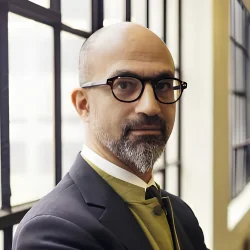
Prof. John E. Fernández
Professor of Building Technology Program in the Department of Architecture and Director of MIT Environmental Solutions Initiative



MIT Professional Education in Numbers
+60K
+155
92%
Frequently Asked Questions
Are any taxes applicable to this program?
Applicable taxes will be calculated and added at checkout in accordance with country/state regulations.
Didn't find what you were looking for? Schedule a call with one of our Program Advisors or call us at +1 315 602 3089.
Register now and boost your professional trajectory.
Enroll by