

ONLINE COURSE
Persuasive Communication: Critical Thinking to Enhance your Message
Communicate with Impact. Influence with Confidence.
Overview
This 9-week online program from MIT Professional Education equips professionals with practical tools to communicate with clarity and influence. Designed for leaders, managers, and professionals across industries, it focuses on persuasive messaging, critical thinking, and impactful storytelling for business success.
Why enroll in this course?

Strengthen your ability to influence decisions and shape perceptions in diverse business contexts.

Master storytelling techniques and persuasive narratives to drive engagement and action.

Enhance your critical thinking skills to present complex ideas clearly and confidently.

Adapt communication strategies to different audiences, cultures, and digital channels.

Join two live sessions with MIT instructors, plus up to eight interactive sessions with industry experts, learning facilitators, and global peers.

Gain access to curated supplementary resources that deepen your understanding and extend your learning beyond the core modules.
What will you learn?
Learn about disparate communication styles and how they influence attitudes and behaviors.
Discover the psychology behind persuasion and implement it in your own professional interactions.
Understand what characteristics make a great public speaker and learn how to apply them to yourself.
Master how to adapt your message to different audiences, including those with differing levels of technical knowledge.
Explore the impact of digitalization in communication and learn to manage virtual communications in an effective, powerful manner.
Find out which processes are behind critical thinking and how to use them to enhance your message.
Comprehend the importance of data visualization to clarify your data for any kind of audience.
Devise a communication strategy for your organization.
Course outline
Introduction
Be introduced to the concept of persuasion and its theory
Understand the difference between “fast” and “slow” persuasion
Learn about the role of motivation, ability, and time (opportunity) in persuasive interactions
Learn how communication and persuasion can influence work environments
The Public Speaker
Be introduced to the main models of communication, with particular reference to Aristotle’s linear model
Understand how to deliver and communicate your persona
Learn how to cultivate your persona and strengthen your likability
Learn the 12 steps to effective public speaking
Storytelling
Learn the history of storytelling and its impact
Understand how to use the power of storytelling in persuasion
Identify when to use storytelling rather than make an argument
Critical Thinking 101
Understand how argumentation can affect persuasion
Identify key forms of reasoning
Determine the challenges of shared criteria
Introduction to Data Visualization
Discover the importance of data visualization in persuasion
Identify good and bad data visualization
Learn how to implement effective data visualization
Understand how to implement effective data visualization
Adapting Messages and Media to Audiences
Learn how to adapt your messages to different media and audiences
Prepare for the global workplace by understanding how to communicate with multicultural audiences
Discover ways to adapt scientific and technical messages to non-expert audiences
Examine how to work with hostile audiences
Digital Persuasion
Understand how new technology shapes the way we work and communicate
Learn to use digital presentations to reinforce what you are conveying
Learn how to effectively manage your social media persona
Visual Persuasion
Learn the importance of visual persuasion
Understand how to bring your message and medium into alignment
Learn how to communicate your online identity visually
Conclusion: Devising a Communication Strategy
Learn to identify and tackle your most persistent communication challenges
Define how you want to be perceived by others and work toward it
Assess your digital-competence level in the area of persuasive communication
Who is this online course for?
C-level executives wanting to improve both vertical and horizontal communication to ensure that objectives are aligned throughout their organization
Engineers and other technical professionals who need to communicate with those from nontechnical backgrounds, as well as people without technical knowledge who need to communicate with engineers and other tech professionals
Any professional looking to enhance their critical thinking by constructing and evaluating claims and arguments that can be confidently presented to persuade others within their organization and beyond it
Business leaders who need to deliver data and information across a variety of media channels to diverse audiences
Sustainability and climate change specialists looking to incorporate knowledge about portfolio management, programs, and projects
Entrepreneurs and other dynamic professionals who rely on effective communication to turn their ideas into actionable plans for presentation
Instructor

Prof. Edward Schiappa
John E. Burchard Professor of Humanities and Co-chair of the Gender Equity Committee of the School of Humanities, Arts & Social Sciences - MIT | Coordinating Instructor
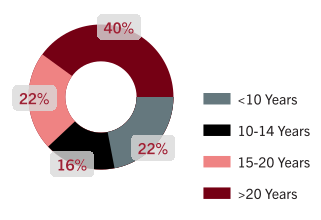
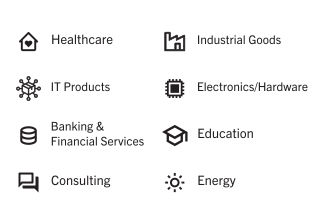
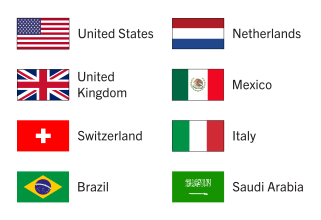
Past participants profile
Work Experience
Top Industries
Top Countries
Participant testimonials



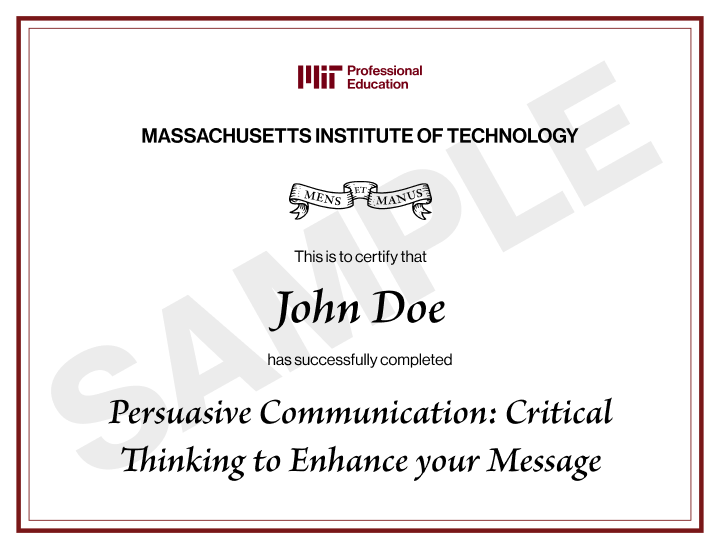
Certificate
All the participants who successfully complete their program will receive an MIT Professional Education Certificate of Completion, as well as Continuing Education Units (CEUs)*.
To obtain CEUs, complete the accreditation confirmation, which is available at the end of the course. CEUs are calculated for each course based on the number of learning hours.
*The Continuing Education Unit (CEU) is defined as 10 contact hours of ongoing learning to indicate the amount of time they have devoted to a non-credit/non-degree professional development program.
To understand whether or not these CEUs may be applied toward professional certification, licensing requirements, or other required training or continuing education hours, please consult your training department or licensing authority directly.
MIT Professional Education in Numbers
+60K
+155
92%
Frequently Asked Questions
Are any taxes applicable to this program?
Applicable taxes will be calculated and added at checkout in accordance with country/state regulations.
Connect with a Program Advisor for a 1:1 Session
Didn't find what you were looking for? Schedule a call with one of our Program Advisors or call us at +1 315 602 3089.
Register now and boost your professional trajectory.
Enroll by