

ONLINE COURSE
Management of Technology:
Why enroll in this course?

Obtain advanced tools and learn different methodologies to design technology portfolios in a wide variety of sectors.

Establish and operate an efficient technology scouting organization and its related procedures.

As your final project, create a detailed R&D strategy and technology portfolio, based on technology roadmaps, for the organization of your choice.

Engage in two live sessions with MIT instructors, and up to eight live sessions with learning facilitators, industry experts, and peers.

Networking opportunities establish professional connections with industry experts and your cohort.

Access to rich supplementary resources provides additional materials and content for a more thorough educational journey.
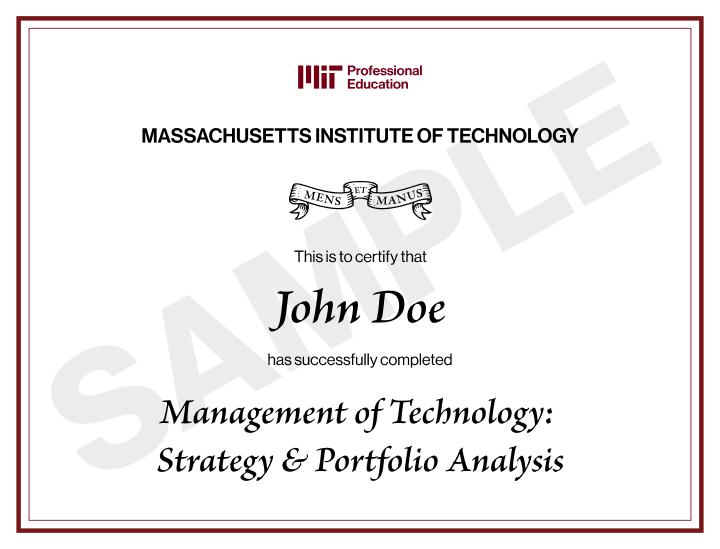
Certificate
All the participants who successfully complete their program will receive an MIT Professional Education Certificate of Completion, as well as Continuing Education Units (CEUs)*.
To obtain CEUs, complete the accreditation confirmation, which is available at the end of the course. CEUs are calculated for each course based on the number of learning hours.
*The Continuing Education Unit (CEU) is defined as 10 contact hours of ongoing learning to indicate the amount of time they have devoted to a non-credit/non-degree professional development program. To understand whether or not these CEUs may be applied toward professional certification, licensing requirements, or other required training or continuing education hours, please consult your training department or licensing authority directly.
Course outline
Systems Modeling and Technology Sensitivity Analysis
Quantitative system modeling of technologies
Long-range mission example: Boeing 747-400
Technology sensitivity and partial derivative
Role of constraints (Lagrange multipliers)
Examples
Quick review
Technology Infusion Analysis and Case Studies
Introducing the concept of Technology
Infusion Analysis (TIA)
Problem statement
Literature review and gap analysis
Case study 1: Hydrogen fuel reformer "Plasmatron"
Technology infusion framework
Case study 2: Technology infusion in a printing system
Roadmapping Case Study: The Deep Space Network
Evolution of the Deep Space Network
Technology roadmap of complex industries: DSN
Industry roadmapping equations
Analysis of DSN technologies
Technology Scouting, Knowledge Management, and Technology Transfer
Sources of technological knowledge
Technology clusters and ecosystems
Technology scouting
Venture capital and due diligence
Competitive Intelligence and Industrial Espionage
Technological representations
Knowledge management (KM)
Technology transfer (TT)
Reverse engineering
Roadmapping Case Study: Advancements in DNA Research
Examining early technologies
Evaluating technological costs: DNA sequencing
Significance of emerging trends: Biotech
R&D Project Definition, Portfolio Management, Tech Evaluation and Finance
Types of R&D projects
R&D individual project planning
R&D project execution
R&D portfolio definition and management
R&D portfolio optimization
Total factor productivity (TFP) and technical change
Research and development and finance in firms
Examples of corporate R&D
Technology valuation (TeVa)
Summary of technology valuation methodologies
Innovation of Intelligence Technologies
History of intelligence technology
Evolution of artillery
Impact of commercialization: examining military and intelligence technologies
Impact of Technological Innovation on Industrial Ecosystems
Interaction between technological innovation and industrial structure
Dynamics of innovative ecosystems and industries
Proliferation and consolidation
System dynamics modeling of technological innovation
Nuclear power in post-WWII France
Electric vehicles in France
Comparative analysis
The Future of Technology
Changing demographics
Technology adoption by seniors
Universal desig
Ultimate limits of technology
The singularity
Human augmentation with technology
Utopia or dystopia?
Summary: seven key messages
Who is this online course for?
CTOs, CINOs, and leaders of technological departments or projects who need to understand the evolution of technology and optimal technology management for their organizations.
Technical professionals who want to obtain a broader strategic vision of how methods and tools of technology management can transform their business operations.
CEOs, entrepreneurs, and functional managers in technical areas or sectors looking to create new business models and scale up their current operations.
Professionals who want to understand digital transformation opportunities and its benefits for their organization.
Instructor

Prof. Olivier De Weck
Professor of Aeronautics and Astronautics and Engineering Systems, MIT
MIT Professional Education in Numbers
+60K
+155
92%
Frequently Asked Questions
Are any taxes applicable to this program?
Applicable taxes will be calculated and added at checkout in accordance with country/state regulations.
Didn't find what you were looking for? Schedule a call with one of our Program Advisors or call us at +1 315 602 3089.
Please note that our team is away from December 22, 2026 to January 5, 2027 for the year-end holidays. We look forward to addressing your queries when we resume operations in the new year.
Register now and boost your professional trajectory.
Enroll by