

ONLINE COURSE
AI-Driven Leadership
Course Overview
AI-Driven Leadership (Formerly Leadership in the Age of AI) equips executives and business leaders with the strategic insights and practical frameworks needed to lead in an AI-driven world. The course focuses on helping leaders identify high-impact opportunities, shape AI strategy, manage risk, align stakeholders, and drive measurable business outcomes. Each module is designed to help you make more informed decisions, lead AI initiatives with confidence, and translate emerging technologies into meaningful organizational impact.
What Will You Learn
The New Era of Digital Transformation
Identify the key capabilities necessary for thriving in a digitally powered business environment
Analyze the role of technology in driving organizational transformation across various industries
Explore examples of successful digital transformation in sectors like healthcare, finance, and manufacturing
Making Sense of Artificial Intelligence
Understand the distinctions between traditional AI, machine learning, deep learning, and generative AI, and how each can contribute to business transformation
Apply the “Gen AI Cost Equation” to identify business scenarios where the use of GenAI can drive productivity
Gain insight into emerging AI trends and how they can benefit businesses
Living and Working With Non-Human Collaborators
Assess the current capabilities of robots and autonomous systems in both hardware and software forms.
Analyze the implications of human-machine collaboration for the future of work.
Driving Transformational Change
Analyze the key leadership capabilities of digital mastery.
Identify the key components of a compelling vision.
Utilize the “three lenses” framework to engage stakeholders in digital transformation initiatives.
Outline a robust governance strategy to drive coordination across AI, digital, and other activities.
Examine methods to engage employees in making the vision a reality.
Thriving in Webs of Connectivity: The Internet of Things and Digital Threads
Understand the principles of IoT and digital threads in creating interconnected business environments.
Evaluate how real-time data can be used to diagnose issues and personalize solutions.
Building the Capability to Thrive
Evaluate the key components of a digital and AI-ready culture for your organization.
Understand how to improve the strategic integration between technology and business leaders.
Consider examples of assumptions that may underlie organizational culture and challenge them when they hinder digital transformation.
Peeking over the technology horizon
Explore emerging technologies such as quantum computing, blockchain, and smart sensors
Evaluate the potential for these technologies to drive future business innovation
Develop a basic understanding of the timeline for the broader adoption of these emerging tools
Co-creating the Future
Explore strategies organizations can take toward preparing for an AI-powered future.
Evaluate your organization’s readiness to support ongoing learning, training, and internal mobility.
Apply guiding notions of digital transformation to assess and strengthen organizational readiness.
Develop a roadmap for implementing a transformative digital innovation within your organization.
Key Takeaways for AI-Driven Leadership
By the end of this course, participants will:
Analyze the impact of emerging digital technologies like AI, robotics, and IoT on business models and organizational change
Develop strategies for integrating digital transformation into various industries to improve operational efficiency and customer engagement
Discover how future technological innovations may affect business, workforce, and society, and create the frameworks for sustainable adoption
Assess how real-time data can be applied to identify problems and tailor solutions
Explore changing customer behaviors and preferences in the digital age.
Examine the long-term societal impacts of digital innovations and transformations
Live Webinars with MIT Instructors
This course includes a series of interactive live online sessions designed to enhance learning and bring key concepts to life through faculty-led discussions. Participants will engage directly with MIT instructors to explore the strategic implications of AI, responsible adoption practices, leadership challenges, organizational transformation, and practical frameworks for AI-driven decision making.
These sessions provide an opportunity to deepen understanding through real-world perspectives, guided discussions, and insights from leading experts in the field.
Note: Live session topics and schedules are subject to change and may be updated based on faculty guidance, emerging developments, and evolving industry trends.
Who is this online course for?
Business Executives and Managers responsible for strategic planning, decision-making, and leading digital initiatives who need to comprehend the impact of technologies like AI, IoT, and robotics on their industries.
Technology Leaders and IT Professionals seeking to bridge the gap between rapidly evolving technologies and business objectives to drive innovation and efficiency.
Change Management and Transformation Leaders tasked with leading organizational change, who require insights into effective strategies for driving digital transformation and cultivating a digitally-ready culture.
Entrepreneurs and Innovators looking to leverage advanced technologies to disrupt markets, improve products or services, and stay ahead of emerging trends.
Consultants and Advisors who provide strategic advice on digital transformation, technology adoption, and organizational change management to clients across various industries.
Mid to Senior-Level Professionals Across Industries, especially those in sectors like healthcare, finance, manufacturing, mining, and others undergoing significant digital disruption and seeking to stay competitive.
Past Participants Profile
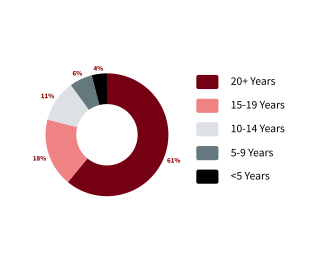
Work Experience
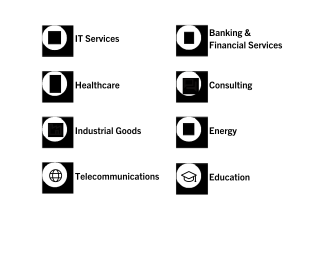
Top Industries
Top Countries

Instructors

Dr. Brian W. Anthony
Director of the MIT Master of Engineering in Advanced Manufacturing and Design. Associate Director, MIT.nano

Prof. Rama Ramakrishnan
Professor of the Practice in Data Science and Applied Machine Learning, MIT Sloan School of Management

Dr. George Westerman
Senior Lecturer and Principal Research Scientist, MIT Sloan School of Management
Participant Testimonials


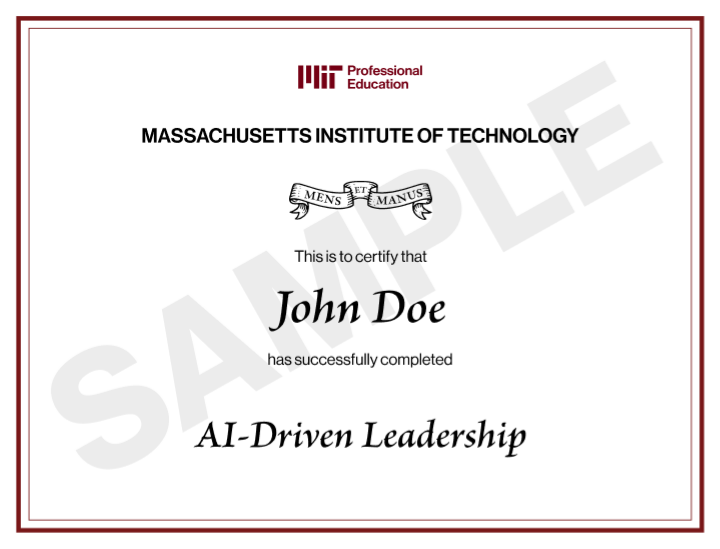
Certificate
All the participants who successfully complete their program will receive an MIT Professional Education Certificate of Completion, as well as Continuing Education Units (CEUs)*.
To obtain CEUs, complete the accreditation confirmation, which is available at the end of the course. CEUs are calculated for each course based on the number of learning hours.
*The Continuing Education Unit (CEU) is defined as 10 contact hours of ongoing learning to indicate the amount of time they have devoted to a non-credit/non-degree professional development program. To understand whether or not these CEUs may be applied toward professional certification, licensing requirements, or other required training or continuing education hours, please consult your training department or licensing authority directly.
MIT Professional Education in Numbers
+60K
+155
92%
Frequently Asked Questions
Are any taxes applicable to this program?
Applicable taxes will be calculated and added at checkout in accordance with country/state regulations.
Connect with a Program Advisor for a 1:1 Session
Didn't find what you were looking for? Schedule a call with one of our Program Advisors or call us at +1 315 602 3089.
Register now and boost your professional trajectory.
Enroll by