

Leading AI Strategy: From Hype to Enterprise Reality
Deploy AI With Clear Strategic Intent
Lead enterprise AI from strategy to execution
The conversation around AI is often shaped by assumptions that do not hold up in real-world applications. This course brings clarity, offering a grounded understanding of what AI is, what it is not, and where its true capabilities and limitations lie in business contexts.
In this 8-week live online course, you will learn to evaluate AI as a practical, operational resource. You will assess what it can reliably deliver, what it costs to implement, and where it is most likely to fail. Through real-world case studies, in-depth modules, and a hands-on capstone project, the course builds a disciplined, evidence-based approach to integrating AI into strategy, decision-making, and organizational design.
Course takeaways
Differentiate between AI hype and strategic reality in business contexts
Analyze the technological and economic foundations shaping modern AI strategy
Evaluate AI as a source of competitive advantage within changing industry environments
Assess organizational approaches to AI integration
Design strategic approaches for aligning AI with organizational priorities
Develop a strategic framework for redesigning organizational structures through AI integration
Course modules
Module 1: The Quest for AGI
Differentiate between explicit and implicit knowledge
Explain the concept of artificial general intelligence (AGI) as it is commonly presented
Analyze the claim that AGI represents a near-term business reality
Analyze the historical and future cycles of AI development and failure
Apply the historical cycles of digital development and failure to organizational strategy
Module 2: Technology and Capabilities of AI
Distinguish deterministic programming from AI-based systems
Identify how neural networks enable AI systems to learn from data
Describe foundational mechanisms that enable modern AI systems to function
Evaluate the capabilities and limitations of AI systems
Compare the capabilities and limitations of AI systems
Analyze how AI systems function and where they may succeed or fail
Module 3: The Quirky Co-Worker: The Realities of AI and Work
Evaluate real-world examples of AI implementation for patterns of success and failure
Differentiate between tasks that are well suited for AI augmentation vs. those requiring human judgment
Differentiate between advisory, auditing, and agentic roles of AI in workplace contexts
Assess the hierarchy of risk associated with AI applications based on stakes and potential consequences
Determine appropriate configurations of human and AI roles within a given task or workflow
Module 4: Giganomics: The Economics of AI
Identify the three types of economic value created by AI adoption
Identify how AI adoption, usage, and cost drivers contribute to the economic value of AI within an organization
Evaluate how AI adoption, usage, and cost drivers influence the economic value of AI within an organization
Explain how organizations move from individual AI use to organizational AI implementation
Evaluate the costs, benefits, and risks of using AI in an organizational workflow
Module 5: The Bionic Enterprise
Describe how human–AI hybrid systems reshape organizational roles and reporting structures
Differentiate between human-owned tasks and AI-executable tasks within a hybrid workflow
Explain the concept of task–risk alignment in assigning oversight within hybrid systems
Assign a task-risk human oversight “framework” to AI-driven tasks
Analyze how an AI-native organization structures roles, risk tolerance, and operations
Compare the structural constraints of AI-native organizations and legacy enterprises
Evaluate how risk tolerance influences organizational design decisions in hybrid systems
Module 6: AI and Strategy
Differentiate between Layer 1 (transactional) and Layer 2 (relational) competitive advantages in the context of incumbents and startups
Evaluate which organizational tasks and processes can be transactionified versus those that require relational or contextual judgment
Assess AI use cases using a risk–impact framework to determine appropriate implementation pathways
Module 7: Governance, Ethics, and Legalities
Differentiate between corporate, ethical, and legal risks associated with AI implementation
Assess organizational exposure to risk across operational, reputational, legal, and environmental dimensions
Analyze how evolving regulatory frameworks and legal systems affect AI deployment
Explain how AI-driven societal impacts influence organizational decision-making
Identify credible sources for monitoring evolving AI regulatory, legal, and societal developments
Define an appropriate organizational response to AI-related risk under conditions of uncertainty
Module 8: The Future
Analyze influences and biases in AI future-facing information
Evaluate the feasibility of a proposed AI or robotics development
Determine managerial actions required to operate in an evolving AI environment
Sequence AI initiatives from incremental adoption to organizational redesign
Industry examples







Note: All product and company names are trademarks or registered trademarks of their respective holders. Their inclusion is for educational illustration only and does not imply affiliation or endorsement.
Live session schedule
Module Title | Date & Time (EST) | |
|---|---|---|
Week 1 | Module 1: The Quest for AGI | December 17, 2026 | 9:30 AM |
Week 2 | Module 2: Technology and Capabilities of AI | January 7, 2027 | 9:30 AM |
Week 3 | Module 3: The Quirky Co-Worker: The Realities of AI and Work | January 14, 2027 | 9:30 AM |
Week 4 | Module 4: Giganomics: The Economics of AI | January 21, 2027 | 9:30 AM |
Week 5 | Module 5: The Bionic Enterprise | February 4, 2027 | 9:30 AM |
Week 6 | Module 6: AI and Strategy | February 5, 2027 | 9:30 AM |
Week 7 | Module 7: Governance, Ethics, and Legality | February 11, 2027 | 9:30 AM |
Week 8 | Module 8: The Future | February 18, 2027 | 9:30 AM |
Note: All session timings are in EST. Session dates and timings are subject to change.
What will you learn
Foundational AI understanding: Understand what AI is, how it works at a high level, and where its limits lie
Capability and constraint evaluation: Assess what AI systems can and cannot do in real-world contexts
Operational assessment of AI: Evaluate how AI systems perform in real operating conditions
Risk awareness: Identify failure points, risks, and implications of overreliance on AI systems
Economic understanding of AI: Interpret cost structures, value creation, and AI investment dynamics
AI integration into organizations: Understand how AI is incorporated into business systems, workflows, and roles
Capstone project
Develop a business strategy for implementing AI within a specific department of your organization through a structured, module-by-module approach.
Participants will work on a single job role or function and progressively build an AI-enabled strategy. Each module includes a required capstone checkpoint, enabling learners to apply concepts directly to their organizational context and build toward a final, integrated strategy.
Why enroll in this course?

Engage in weekly live sessions with an MIT instructor designed to build a clear and structured understanding of AI in business contexts.

Examine real-world case studies to understand how AI performs in practice, including its capabilities, limitations, and strategic implications.

Work on a capstone project to apply course concepts to real organizational challenges and strategic decisions.

Establish professional connections with industry practitioners and a diverse cohort of peers through interactive learning.

Join a global network of professionals engaged in evaluating and applying AI to business strategy and organizational transformation.

Get access to rich supplementary resources, including frameworks and additional materials, to support a more comprehensive learning experience.
This course is an excellent fit for
Professionals responsible for making real decisions about AI, where cost, risk, accountability, and organizational impact matter.
Mid- to senior-level leaders and functional heads seeking to understand how AI influences corporate strategy, competitive dynamics, and enterprise design.
C-suite and business unit leaders navigating AI-driven disruption and building long-term strategic advantage across platforms, ecosystems, and intelligent systems.
Innovation, strategy, and transformation leaders aiming to move beyond pilots and drive enterprise-wide adoption of AI initiatives.
Senior consultants and advisors supporting organizations on AI strategy, operating model redesign, governance, and responsible transformation.
Instructor

Prof Sanjay Sarma
Fred Fort Flowers (1941) & Daniel Fort Flowers (1941) Professor in Mechanical Engineering
Sanjay Sarma is the Fred Fort Flowers (1941) and Daniel Fort Flowers (1941) Professor of Mechanical Engineering at MIT. He was the President and CEO of the Asia School of Busi...
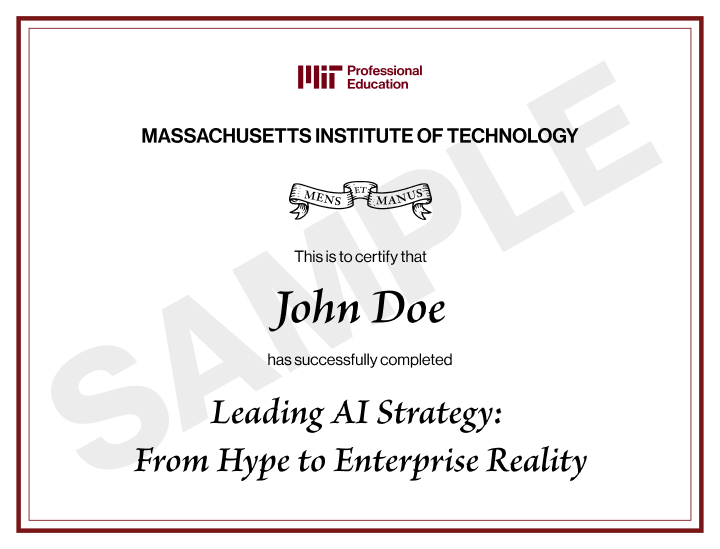
Certificate
All participants who successfully complete Leading AI Strategy: From Hype to Enterprise Reality will receive a MIT Professional Education Certificate of Completion and Continuing Education Units (CEUs).
In order to obtain CEUs, participants must complete a required CEU accreditation form. CEUs are calculated based on the number of learning hours in each course.
MIT Professional Education in Numbers
+60K
+155
92%
Frequently Asked Questions
Do I need a technical background to join?
No. The course is designed for both technical and non-technical professionals. Concepts are explained in practical and accessible terms, with a focus on strategic understanding rather than coding, engineering or building AI models from scratch.
What makes this course different from other AI courses?
Unlike many AI courses focused only on trends, tools or surface-level use cases, this course takes a grounded, evidence-based and business-oriented approach. It helps learners separate real opportunities from hype and understand AI from operational, economic, organizational and strategic perspectives.
How does the course approach AI strategy?
The course approaches AI strategy through a realistic and disciplined lens. Instead of treating AI as a trend, it examines how organizations can assess capabilities, costs, risks, governance needs and long-term business value before making strategic decisions.
Will the course cover real-world business examples?
Yes. The course includes practical case studies and business scenarios that illustrate how organizations are using AI across different functions and industries. These examples help learners understand not only where AI creates value, but also where it can introduce risk, complexity or unrealistic expectations.
Is this course relevant across industries?
Yes. The frameworks and strategic concepts explored in the course are applicable across industries, including technology, finance, healthcare, manufacturing, education, consulting, retail and professional services.
Will I learn how AI could impact the future of my industry?
Yes. The course explores future scenarios and examines how technological, economic, regulatory and organizational changes may reshape industries over time. Learners will develop a more informed perspective on how AI could affect competition, workflows, roles and leadership priorities in their own sectors.
Will I learn how to evaluate whether an AI initiative is worth pursuing?
Yes. A key part of the course is learning how to assess AI initiatives beyond excitement or pressure to adopt the latest technology. You will explore how to evaluate business value, implementation costs, risk, scalability and whether AI is the right solution for a specific organizational challenge.
Does the course address the risks, ethics and governance of AI?
Yes. The course examines the practical risks of AI adoption, including reliability, accountability, liability, oversight, governance and regulatory considerations. Learners will explore how leaders can make responsible decisions while integrating AI into business systems.
What practical frameworks will I gain from the course?
Learners will be introduced to strategic frameworks for evaluating AI’s role in workflows, determining where human oversight is needed, assessing risk and liability, and redesigning organizational processes for effective AI integration.
How will this course help me as a leader?
The course will help you make more informed decisions about AI, ask better strategic questions, evaluate opportunities more critically, and lead AI-related conversations with greater confidence. It is especially useful for leaders who need to guide teams, investments or transformation initiatives in an AI-driven environment.
Are any taxes applicable to this program?
Applicable taxes will be calculated and added at checkout in accordance with country/state regulations.
Connect with a Program Advisor for a 1:1 session
Didn't find what you were looking for? Schedule a call with one of our Program Advisors or call us at +1 315 602 3089.
Register now and boost your professional trajectory.
Enroll by