

ONLINE COURSE
Industrial Internet of Things:
Please note that our team is away from December 22, 2026 to January 5, 2027 for the year-end holidays. We look forward to addressing your queries when we resume operations in the new year.
Why enroll in this course?

Optimize industrial processes by exploring new data-gathering approaches and process controls.

Transform your organization with cutting-edge IoT system development and implementation.

Enhance your ability to envision new opportunities and tackle challenges related to IoT across various sectors.

Engage in two live sessions with MIT instructors, and up to eight live sessions with learning facilitators, industry experts, and peers.

Networking opportunities establish professional connections with industry experts and your cohort.

Access to rich supplementary resources provides additional materials and content for a more thorough educational journey.
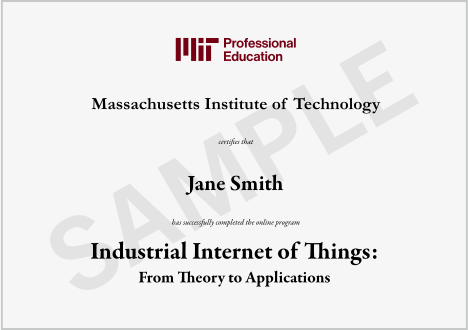
Certificate
All the participants who successfully complete their program will receive an MIT Professional Education Certificate of Completion, as well as Continuing Education Units (CEUs)*.
To obtain CEUs, complete the accreditation confirmation, which is available at the end of the course. CEUs are calculated for each course based on the number of learning hours.
*The Continuing Education Unit (CEU) is defined as 10 contact hours of ongoing learning to indicate the amount of time they have devoted to a non-credit/non-degree professional development program. To understand whether or not these CEUs may be applied toward professional certification, licensing requirements, or other required training or continuing education hours, please consult your training department or licensing authority directly.
Course outline
Introductions, Markets, Needs, and Trends
Gain an insight into the risks and limitations associated with grouping advanced sensors, computation, and communications under one IoT concept.
Learn from real cases how to apply and to characterize the limitations of available technology.
Gain insight into how to realize products and solutions using IoT and beyond IoT approaches and technologies; to use a full system approach when designing and deploying IoT and beyond IoT solutions.
Learn about the application and technology building blocks of the IoT ecosystem and understand how IoT is changing industries, and how to apply it to yours.
Sense Part I
Understand the visualization of a signal in time and frequency domains.
Be able to describe the basics of sensors, and select and compare sensor options.
Know the fundamental properties and characteristics that are important when selecting a sensor.
Sense Part II
Be able to explain the basics of data acquisition and the key issues associated with sampling.
Understand sensors, sensing technologies, and embedded systems in the context of the Internet of Things.
Describe how the Fourier transform decomposes a time signal into the frequencies that it is composed of. Understand how to filter non-fundamental frequencies to remove noise from the sampled signal.
Compute
Learn how to use algorithms and apply them to motivating cases.
Gain insight into the design of a sensing system and the issue of efficiency.
Learn about convolution, and examine examples of machine vision tools and linear filtering.
Review basic statistical theory, and apply this knowledge to relevant cases.
Learn
Be able to distinguish between supervised and unsupervised machine learning methods, and deepen your knowledge about model fitting.
Gain an understanding of ensemble learning methods such as bootstrapping, aggregating, bagging, and boosting.
Examine decision trees and random forests, and be able to assess their strengths and weaknesses.
Know how and when to use optimization machine learning methods such as the support vector machine algorithm and neural nets.
Locate
Gain an understanding of how localization technologies are used in the world today, and how waves and energy propagation form the basis of many of these technologies.
Be able to explain the key concepts behind GPS. Understand the goals of inertial sensing and the components of an Inertial Measurement Unit (IMU).
Grasp the basics of SLAM technology. Know how localization technologies are responding to industry needs.
Communicate
Grasp the basics of communications technology.
Evaluate the suitability of different communications platforms for different situations.
Understand the key issues when evaluating the applications of protocols for different channels.
Integrate Part I
Explain how technology is being used to monitor aerosols in a forest environment.
Understand the process of real-time monitoring in a miniature manufacturing environment using images.
Describe how real-time video is used in production line monitoring and fault detection.
Integrate Part II
Learn about the advantages of using wearable technologies to monitor vital signs.
Gain an understanding of the system design process for vital signs monitoring pods.
Be able to explain how ultrasound imaging can be used to solve problems in the creation of prosthetic limbs.
Who is this online course for?
Business leaders who work in industries that can benefit from knowledge in IoT.
Engineers and engineering managers.
Plant managers working in manufacturing.
Design and manufacturing engineers seeking to learn about data and modeling in a manufacturing environment.
Data scientists looking to apply their craft to the growing field of smart manufacturing.
Consultants who want to add value around the latest technology transformations in manufacturing.
Instructor

Dr. Brian W. Anthony
Director of the MIT Master of Engineering in Advanced Manufacturing and Design. Associate Director, MIT.nano
MIT Professional Education in Numbers
+60K
+155
92%
Frequently Asked Questions
Are any taxes applicable to this program?
Applicable taxes will be calculated and added at checkout in accordance with country/state regulations.
Didn't find what you were looking for? Schedule a call with one of our Program Advisors or call us at +1 315 602 3089.
Register now and boost your professional trajectory.
Enroll by