

Now with the latest advancements in GenAI
Applied AI for Digital Transformation
Build with Generative AI. Lead with Intelligence.
Course Overview
Generative AI is reshaping how organizations create value. This course is purpose‑built for executives and strategic leaders who need to evaluate opportunities, govern responsibly, align stakeholders, and deliver measurable outcomes, not build technical systems. Each module is designed so you can make a better decision, lead a better conversation, or take a more informed action.
What Will You Learn
1
Module 1: Understanding AI and the Business Impact
The evolution of AI: from rule‑based systems to machine learning to generative models
What makes generative AI distinct: creating new content rather than predicting outcomes
Why 2023–2025 marked a major shift in AI adoption and business impact
How AI is reshaping key sectors: healthcare, finance, retail, media, and manufacturing
A leadership‑focused lens for understanding and evaluating AI
Setting personal and organizational goals for learning and application
2
Module 2: How Generative AI Works
What large language models are, explained without technical jargon
How inputs, outputs, and context windows shape model behavior
Why AI hallucinations occur and their impact on organizational use
How tokens, cost, and model size affect budgeting and deployment decisions
What multimodal AI enables across text, images, audio, and code
How leading models differ at a high level and what matters for leadership decisions
Key warning signs to watch for when evaluating AI vendor claims
3
Module 3: Prompt Engineering
What prompt engineering is and why it matters
Core techniques: zero‑shot, few‑shot, chain‑of‑thought, role prompting
Prompting for executive tasks such as briefings, strategy memos, and stakeholder communication
Prompting for team tasks including documentation, summaries, and reporting
Automating routine workflows with reusable prompt templates
Prompt security and what to avoid sharing in public AI tools
Hands‑on practice to build your personal prompt library
4
Module 4: AI Across the Organization
Marketing and CX: personalization, content generation, service automation
Operations: workflow automation, documentation, procurement, supply chain
HR and Talent: recruiting, onboarding, learning and development, performance
Finance: reporting, forecasting, compliance summarization
Product and Innovation: ideation, prototyping, market research
Leadership and Strategy: competitive intelligence, board communication, scenario planning
Case Studies: Klarna, Coca‑Cola, JPMorgan and others
Use‑Case Evaluation: assessing value, risk and organizational readiness
5
Module 5: Ethics, Governance, and Responsible AI
The ethics landscape and what is at stake when AI makes decisions
Where bias in AI comes from and how leaders can mitigate it
Privacy, data sovereignty, and guidelines for employee use of AI tools
When transparency and explainability are required for auditable AI
The regulatory environment, including the EU AI Act, U.S. frameworks, and sector rules
How Responsible AI frameworks from Google, Microsoft, and NIST translate into practice
Disinformation, deepfakes, and content integrity challenges
How to begin building an internal AI policy for your organization
6
Module 6: Building an AI-Ready Organization
What AI readiness means across technology, data, people, and culture
Common failure patterns in AI adoption and how to avoid them
Communicating about AI amid uncertainty and rapid change
Upskilling your workforce and identifying essential future skills
Addressing AI‑related anxiety and supporting psychological safety
Roles of the CDO, CAIO, and AI Center of Excellence
Applying change‑management frameworks such as Kotter and ADKAR to AI initiatives
Building internal AI champions and governance structures
7
Module 7: The AI-Enabled Economy — Workforce, Disruption, and Opportunity
The economic impact of generative AI across productivity, displacement, and new value creation
Which jobs and tasks are most exposed to automation and which remain resilient
AI augmentation versus replacement and how leaders can apply this distinction
How AI is reshaping competitive dynamics through first‑mover advantage and differentiation
What AI‑native competitors reveal and what incumbents can learn from them
Global AI investment trends and their implications for sector strategy
How leadership is evolving and which human capabilities grow in importance
8
Module 8: Creating An AI Strategy
Reviewing the strategic AI framework and bringing all concepts together
Using the AI opportunity canvas to map use cases to business value
Applying an effort‑impact‑risk matrix to prioritize AI initiatives
Building an AI roadmap across quick wins, mid‑term initiatives, and long‑term transformation
Crafting the business case for AI investment and making the ask effectively
Presenting your AI strategy to boards, investors, and skeptical stakeholders
Capstone workshop to develop and peer‑review your organizational AI strategy
Final reflection on the kind of AI leader you aim to become
Gain experience with popular AI tools
Disclaimer: All product and company names are trademarks or registered trademarks of their respective holders. Use of product and company names does not imply any affiliation with or endorsed by MIT Professional Education.
Core Learning Objectives for AI‑Enabled Decision Making
Design a prioritized AI opportunity map and adoption roadmap with risks, dependencies, and success metrics
Assess where GenAI creates value across functions and judge feasibility/ROI for your context
Apply prompt‑engineering techniques to automate routine executive and team workflows
Evaluate ethical risks and map governance requirements to recognized frameworks in your organization
Distinguish among core AI capabilities (LLMs, RAG, agents, multimodal, to support informed vendor and solution decisions.
Develop a practical AI adoption framework that includes change management and stakeholder alignment
Analyze workforce and economic implications to inform org design and competitive strategy
Explain the foundations, evolution, and business relevance of generative AI
Capstone Project
The course includes a capstone project where learners synthesize concepts from all modules into an actionable AI strategy for their organization. Participants develop a prioritized opportunity map, build an adoption roadmap with owners and timelines, and outline key risks, dependencies, and success metrics. The capstone ensures that every learner leaves with a concrete, organization-ready plan that translates learning into practical, strategic action.
Live Webinars with MIT Instructors
This program includes a series of interactive, instructor‑led live webinars that deepen learning across key Generative AI concepts. Through guided discussions and real‑world illustrations, you will engage directly with MIT instructors to explore strategic applications of generative AI, organizational implications, responsible adoption, and decision‑making frameworks relevant to leaders.
Live sessions are continuously reviewed and evolve to reflect emerging insights, real‑world developments, and faculty guidance.
Note: Live session webinars are subject to change and may be updated based on instructors guidance.
Who is this Online Course for?
Senior leaders in charge of making decisions regarding generative AI initiatives in their organizations.
Technology leaders seeking to master the latest best practices for adopting and optimizing generative AI systems to enhance business outcomes.
Senior and mid-career executives interested in the potential applications of generative AI in their organizations.
Innovation managers, sales and product managers, and marketing and CX professionals seeking to leverage generative AI to create new products, content, and personalized customer experiences.
Venture capital, private equity, and/or pension fund investors interested in the investment opportunities created by generative AI.
Professionals from all industries and sectors interested in joining a dynamic learning ecosystem.
Prerequisites: No prior background in analytics, computer science, coding or machine learning is required.
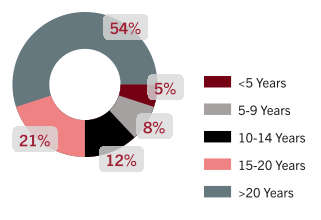
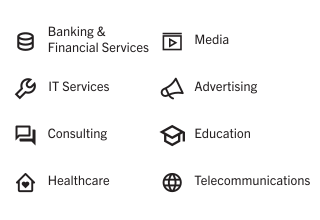
Past Participants Profile
Work Experience
Top Industries
Top Countries

Instructors

Dr. Abel Sanchez
Research Scientist, MIT

Prof. John R. Williams
Professor, MIT Department of Civil and Environmental Engineering; Affiliated Faculty, MIT Center for Computational Science and Engineering.
Faculty Contributor

Prof. Armando Solar-Lezama
Professor in MIT’s Department of Electrical Engineering and Computer Science; Head of Computer-Assisted Programming Group and Associate Director and COO of MIT Computer Science and Artificial Intelligence Laboratory
Industry Contributors

Jacob Depriest
Deputy Chief Security Officer at GitHub

Susan Doniz
Chief Information Officer and Senior Vice President of Information Technology and Data Analytics at The Boeing Company

Katie M. Lewis
Generative AI Researcher at Runway

Mark Schwartz
CIO and Enterprise Strategist at Amazon Web Services
Participant Testimonials
This course is excellent for learning about the fundamentals of generative AI. It covers various concepts such as limitations, applications to your workplace organization (i.e., tech and business related), and ethical concerns. I enjoyed how the assignments allow you to apply the key concepts learned. I work in biotech, and it definitely opened my eyes to the possibilities generative AI can have on my field. ...

Ariane Nissenbaum
Senior Associate Scientist,
NanoVation Therapeutics
Enrolling in the MIT Applied AI for Digital Transformation program has been a transformative experience for me, both personally and professionally. Coming from the IT solutions and services industry, I was eager to understand how Generative AI could reshape business models, enhance automation, and drive innovation. This program not only met but exceeded my expectations....

Vineet Gulati
Senior Client Partner,
Infobahn Softworld Inc
As a technology executive who has witnessed the rapid evolution of AI, I highly recommend MIT's Applied AI for Digital Transformation course for its comprehensive and practical approach to understanding this transformative technology. The combination of technical depth and business application, delivered by distinguished MIT faculty like Prof. Williams and Dr. Sanchez, provides invaluable insights for professionals looking to lead AI initiatives in their organizations. The course's focus on both implementation strategies and ethical considerations makes it an essential investment for anyone serious about leveraging generative AI for business transformation....

Martin Limbach
Geschäftsführer (Managing Director),
PwC Solutions GmbH
Absolutely. This course has made me more intentional in how I evaluate technology—not just as a tool, but as a strategic partner. In my role, it's easy to default to traditional models when leading change or building strategy, but the exposure to generative AI has shifted my perspective. I now find myself questioning not only what we’re doing, but how we’re doing it—and whether AI can help us do it smarter.
Personally, it’s also sparked a sense of curiosity I haven’t felt in a long time. I’m exploring new AI tools, thinking about how to reskill teams, and having more open conversations with colleagues about the future of work. The biggest shift is mindset—seeing AI not as a distant concept, but as a practical enabler of transformation that’s already within reach. ...

Muhammad Abbas Khan
Chief Strategy Officer,
Tanmiah Food Company
I’ve started exploring how LLMs can help automate my professional work - test case generation, summarize defect logs, and even support data validation logic. I am even using Chatgpt for my personal finance advise. Some of the results are really amazing. Thanks to this course, and material - the tools and technologies mentioned in this course really helped me. ...

Ravneet Singh Chhabra
Senior QA Automation Engineer,
Cigna Healthcare
Yes, this course has created a meaningful shift in how I think and act—both professionally and personally. It gave me the clarity to structure a clear roadmap for applying AI in real-world settings, from research and prototyping to testing business use cases.
While I’m still in the early stages, the course helped me move from curiosity to structured action. I’ve identified specific opportunities to apply AI in my organization and outlined a personal ambition to turn AI knowledge into a side venture or monetizable project. What felt abstract before now feels tangible and achievable.
More than anything, I now see AI not just as a tool, but as a strategic enabler for innovation, new revenue streams, and future growth. ...

Salvador Nunez
Sr. Director IT Service Strategy & Digital Service Transformation,
Convatec
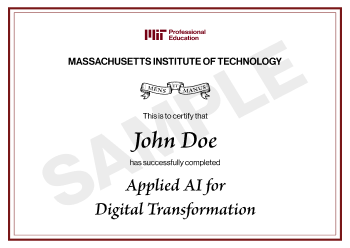
Certificate
All the participants who successfully complete their program will receive an MIT Professional Education Certificate of Completion, as well as Continuing Education Units (CEUs)*.
To obtain CEUs, complete the accreditation confirmation, which is available at the end of the course. CEUs are calculated for each course based on the number of learning hours.
*The Continuing Education Unit (CEU) is defined as 10 contact hours of ongoing learning to indicate the amount of time they have devoted to a non-credit/non-degree professional development program.
To understand whether or not these CEUs may be applied toward professional certification, licensing requirements, or other required training or continuing education hours, please consult your training department or licensing authority directly.
MIT Professional Education in Numbers
+60K
Participants in our courses
+155
Countries represented by our participants
92%
Rate the experience as extraordinary
Frequently Asked Questions
1
Do I need a technical background to succeed in this course?
No. The course is intentionally designed for professionals without coding or machine‑learning expertise. All concepts, demonstrations, and tools are presented in accessible, plain language suitable for an executive or strategic audience.
2
How is the course structured across the eight modules?
The modules follow a strategic progression: foundations → how GenAI works → prompt engineering → organizational applications → ethics/governance → AI‑ready culture → economic implications → final AI strategy capstone. Each module builds toward leadership capability, not technical mastery.
3
What types of case studies are included?
The course integrates cross‑industry case studies (e.g., marketing, operations, HR, finance, innovation) and real examples from companies like Klarna, Coca‑Cola, JPMorgan, Microsoft, and others. These are used as supporting examples—not full case studies—to illustrate practical applications and emerging patterns.
4
Are any taxes applicable to this program?
Applicable taxes will be calculated and added at checkout in accordance with country/state regulations.
5
Is there a capstone project? What does it involve?
Yes. The course concludes with a capstone where learners synthesize all concepts into an actionable AI strategy. You will create an opportunity assessment, a prioritized roadmap, ownership and timeline plans, risk and dependency mapping, and a clear set of success criteria.
6
What practical tools will I walk away with?
You will build three core artifacts:
A Prompt Library for Leaders
A Responsible AI Governance Checklist
An AI Adoption Framework tailored to your organizational context
These resources are designed for immediate real‑world use.
7
Are there hands‑on activities or only lectures?
Each module includes guided activities, practical analysis, a formative quiz, and applied exercises. Supplemental “for the technically curious” resources offer deeper exploration but are optional.
8
How is assessment handled in the redesigned course?
All key assignments include rubrics aligned with updated, measurable learning outcomes. These clarify expectations and ensure consistent evaluation across learners.
9
How current is the content with rapid AI advancements?
The redesign updates outdated tools, references, and demos; emphasizes evergreen concepts; and moves fast‑changing examples to lighter-touch modules, live sessions, or optional content. Regulatory and governance content is aligned with the EU AI Act, U.S. frameworks, and emerging global standards.
10
Are live sessions included?
Yes. Instructor-led sessions are incorporated to clarify complex topics, provide updated context, and deepen engagement. Faculty sessions may vary by cohort based on availability.
11
What level of time commitment should I expect?
Learners typically spend 4–6 hours per module, including videos, activities, readings, practice exercises, and the capstone. The course is designed for working professionals.
12
Does the course cover multimodal AI and emerging capabilities?
Yes. The redesign includes multimodal AI (text, image, audio, code) and introduces future-forward concepts like agents, long-context models, and advanced prompting—presented with non-technical clarity.
13
How does the course address ethics and governance?
A dedicated module covers bias, transparency, risk management, disinformation, and regulatory requirements. Learners also build a practical governance checklist aligned with recognized frameworks (NIST, Microsoft, Google, EU AI Act).
14
What is the target audience for this program?
Business leaders, functional heads, cross‑functional collaborators, non‑technical professionals, product and operations leaders, and project managers overseeing AI‑related work—especially within engineering or scientific environments.
Connect with a Program Advisor for a 1:1 Session
Didn't find what you were looking for? Schedule a call with one of our Program Advisors or call us at +1 315 602 3089.
Save up to 15% when you enroll in two complementary AI courses.
Applied AI Bundle - Generative and Agentic AI
Benefit From Up To 15% Savings on This Bundle
As organizations move from experimenting with AI to implementing it at scale, professionals need expertise in both Generative AI and Agentic AI to drive meaningful business transformation.
The Applied AI Bundle - Generative and Agentic AI gives you access to two complementary MIT Professional Education online courses, Applied AI for Digital Transformation and Applied Agentic AI for Organizational Transformation, while offering up to 15% savings on total course fee compared to enrolling in the courses separately. Together, the two courses help you build practical capabilities across AI strategy, enterprise integration, workflow automation, governance, and organizational transformation.
The Applied AI Bundle - Generative and Agentic AI gives you access to two complementary MIT Professional Education online courses, Applied AI for Digital Transformation and Applied Agentic AI for Organizational Transformation, while offering up to 15% savings on total course fee compared to enrolling in the courses separately. Together, the two courses help you build practical capabilities across AI strategy, enterprise integration, workflow automation, governance, and organizational transformation.

Register now and boost your professional trajectory.
Enroll by