

ONLINE COURSE
Digital Platforms:
Why enroll in this course?

Design and develop effective digital platforms for intuitive and user-friendly experiences.

Create a merchant side of the platform which is conducive to the vendors' success.

Make informed decisions and differentiated products by leveraging digital platforms.

Engage in two live sessions with MIT instructors, and up to eight live sessions with learning facilitators, industry experts, and peers.

Networking opportunities establish professional connections with industry experts and your cohort.

Access to rich supplementary resources provides additional materials and content for a more thorough educational journey.
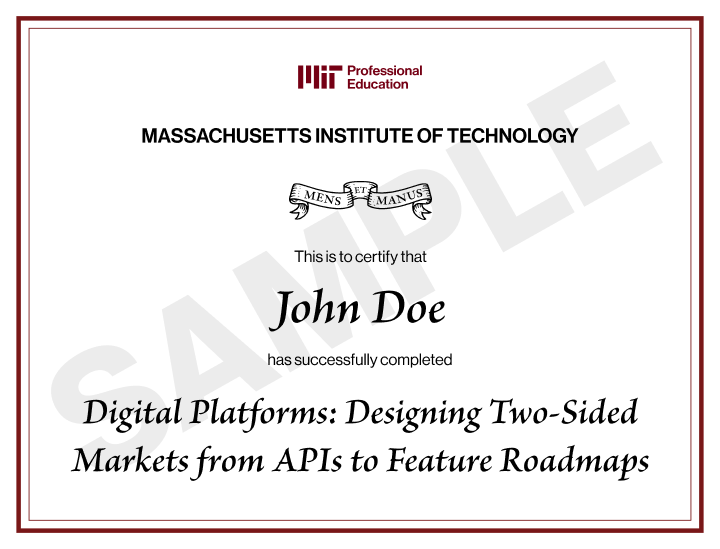
Certificate
All the participants who successfully complete their program will receive an MIT Professional Education Certificate of Completion, as well as Continuing Education Units (CEUs)*.
To obtain CEUs, complete the accreditation confirmation, which is available at the end of the course. CEUs are calculated for each course based on the number of learning hours.
*The Continuing Education Unit (CEU) is defined as 10 contact hours of ongoing learning to indicate the amount of time they have devoted to a non-credit/non-degree professional development program. To understand whether or not these CEUs may be applied toward professional certification, licensing requirements, or other required training or continuing education hours, please consult your training department or licensing authority directly.
Course outline
Industry Platforms: The Basics
Define industry platforms, and differentiate between types of industry platforms
Define network effects such that they can be evaluated for the strength of their effect
Separate two-sided markets from traditional seller-buyer relationships
What Does a Successful Digital Ecosystem Look Like?
Develop an understanding of what makes a platform successful
Provide insight and context through examples of popular two-sided marketplaces
Test your knowledge of the five effects from Module 1
Initiation and First Transitions
Recognize a two-sided market and distinguish it from traditional one-sided or direct seller/buyer markets
Critically analyze and discuss examples of industry platforms
Identify factors for the success and failure of two-sided markets
Architecture of Digital Platforms
Define consumer needs
Understand the architectural components that are integral to enable a platform strategy
Identify the key considerations around scaling a platform
Growing the Platform: Ensuring Quality and Robustness
Be able to describe the importance of quality control and the mechanism of gating
Select the degree of "openness" of the platform and select the best APIs for your platform
Understand the key choices for scaling your digital infrastructure in terms of a monolithic versus distributed architecture
Growing the Platform: Users and Partners
Identify strategies to build a competitive platform
Understand how to grow & enable partners
Study international expansion and potential for copycat platforms
Platform Dynamics
Gain an understanding of why it is useful to model two-sided markets, and what is the latest research in the field
Understand the two main approaches to model two-sided markets: Through system dynamics and Agent-based modeling
Learn more about the Google Ara use case
Summary and Recap
Perform a deep-dive into a platform
Review the master diagram
Review core learning objectives of the course
Who is this online course for?
C-suite and other executives looking to gain a deeper technical understanding of digital platforms in order to make more effective decisions for their organization.
Developers and engineers who work with digital platforms and want to learn about the key technical choices of two-sided markets, such as software development kits or application programming interfaces (APIs).
Product managers who want to leverage their technical choices for a dynamic digital platform strategy in the online marketplace.
Entrepreneurs looking to develop start-ups centered around digital platforms and two-sided markets and who want to ensure their company’s success in the online marketplace.
Policy experts and regulator who work with digital market policies in an expanding global economy.
Professionals from technical backgrounds who work with digital platforms and two-sided markets who want to understand the choices they can make to enable their success.
Instructors

Dr. Bruce Cameron
Director, System Architecture Group at MIT

Prof. Olivier De Weck
Professor of Aeronautics and Astronautics and Engineering Systems, MIT
MIT Professional Education in Numbers
+60K
+155
92%
Frequently Asked Questions
Are any taxes applicable to this program?
Applicable taxes will be calculated and added at checkout in accordance with country/state regulations.
Didn't find what you were looking for? Schedule a call with one of our Program Advisors or call us at +1 315 602 3089.
Please note that our team is away from December 22, 2026 to January 5, 2027 for the year-end holidays. We look forward to addressing your queries when we resume operations in the new year.
Register now and boost your professional trajectory.
Enroll by