

ONLINE COURSE
Competitive Strategy:
Why enroll in this course?

Boost your organization's positioning with sustainable strategies that reduce environmental impact while enhancing efficiency and long-term profitability.

Enhance your sustainable leadership skills to craft high-impact initiatives, drive transformational change, and strengthen your position as a market leader.

Strengthen your strategic planning and craft long-term roadmaps to drive sustainable innovation and gain a competitive advantage.

Engage in two live sessions with MIT instructors, and up to eight live sessions with learning facilitators, industry experts, and peers.

Networking opportunities establish professional connections with industry experts and your cohort.

Access to rich supplementary resources provides additional materials and content for a more thorough educational journey.
What will you learn?
Master how to navigate transformative forces and analyze business models for effective adaptation to emerging trends.
Create strategic initiatives that balance profitability with sustainability, cultivating an overall competitive advantage.
Examine real-world case studies and examples to determine the best strategic changes for organizations.
Engage and manage diverse stakeholders to support sustainable initiatives.
Learn how to transition from 'business as usual' to a sustainable economy by leveraging technology, understanding policy frameworks, and applying innovative business models.
Lead with sustainable innovation and strategy, while understanding the global impacts on business transformation to ensure future success.
Lead and manage organizational change and transformation effectively.
Analyze business models to develop comprehensive strategies for creating, delivering, and capturing value.
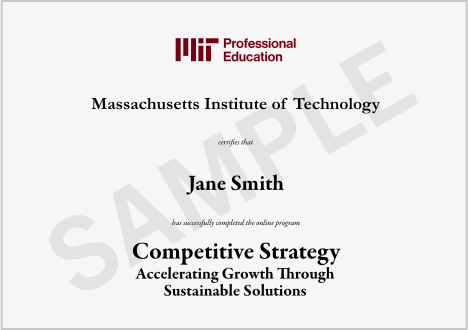
All the participants who successfully complete their program will receive an MIT Professional Education Certificate of Completion, as well as Continuing Education Units (CEUs)*.
To obtain CEUs, complete the accreditation confirmation, which is available at the end of the course. CEUs are calculated for each course based on the number of learning hours.
*The Continuing Education Unit (CEU) is defined as 10 contact hours of ongoing learning to indicate the amount of time they have devoted to a non-credit/non-degree professional development program.
To understand whether or not these CEUs may be applied toward professional certification, licensing requirements, or other required training or continuing education hours, please consult your training department or licensing authority directly.
Course outline
What is strategy?
Understand how strategy shapes organizational success
Explore how strategic decisions influence the design and implementation of business models to achieve sustainable competitive advantage
Evaluate real-world examples to understand how successful companies align their business models with strategic objectives
Aligning Business Strategy and Sustainability
Gain insight into firms' motivations and approaches for including sustainability in their strategic goals
Delve into the “four lenses” framework as a guide for determining which aspects of sustainability matter the most to organizations
Explore methods for aligning business strategy with sustainability goals
Planetary Boundaries and the Sustainability Imperative
Identify and assess the impacts of climate change on/from organizations
Test and explore cross-sector climate solutions using the En-ROADS simulator
Explore the effects of local impacts on climate justice and co-benefits
Technological Innovation and Business Models for Decarbonization
Understand the concept of decarbonization and its importance in combating climate change
Explore how technological innovation drives decarbonization efforts
Analyze the case study of CEMEX to evaluate its commitment to decarbonization
Determine the actionable steps organizations can take to prepare for the long-term, considering the evolving landscape of decarbonization and business sustainability "
Scenarios and Pathways for Decarbonization
Use climate scenarios and roadmaps to envision future climate outcomes and guide the development of technology, policy, and business strategies at the firm level
Relate firm-level climate pathways to broader sectoral and economic scenarios, analyzing how individual corporate actions might align with overall climate goals
Apply climate scenarios to test the robustness of strategic choices, enhancing corporate decision-making through climate-based scenario planning
Capabilities for Sustainable Business Strategies
Grasp core competencies and how they support value creation, delivery, and capture in business settings
Identify existing and necessary core competencies and assess whether their overlap gives your organization a competitive advantage
Transform organizational capabilities into sustainable business models using the RAT (Relevant, Appropriable, Transferable) test
Innovation Strategy: What, When, Where?
Hone your ability to strategically plan and implement innovative practices to maintain competitive advantage.
Implement the Sustainable Oriented Innovation (SOI) framework to a real-world business setting to promote sustainability within the innovation process.
Critically assess the perceived trade-off between sustainability and profitability, exploring how integrating sustainability into the innovation process can influence a firm's financial performance & long-term success.
Driving Eco-system Level Change
Identify and characterize the relevant stakeholders that must be involved in realizing systems change
Explore the components of a “virtuous circle”
Learn how to create a developer proposal
Who is this online course for?
Leaders, Entrepreneurs, and Investment professionals aiming to innovate and drive financial growth through new strategic initiatives.
Mid-career to senior-level professionals holding managerial positions across any sector who want to explore business models for strategic transformation to make their organizations more competitive.
Corporate Strategists, Operations Managers, Sustainability Managers, or Directors of Sustainability who have a genuine interest in examining innovative techniques to enhance organizational performance and growth.
Advisors and Consultants at local, national, and international levels passionate about steering organizations towards long-term success through innovative and sustainable strategic approaches.
Instructor

Prof. Donald R. Lessard
Epoch Foundation Professor of International Management and Professor of Systems Engineering, Emeritus, at MIT and Distinguished Visiting Professor, Asia School of Business
MIT Professional Education in Numbers
+60K
+155
92%
Didn't find what you were looking for? Schedule a call with one of our Program Advisors or call us at +1 315 602 3089.
Frequently Asked Questions
Are any taxes applicable to this program?
Applicable taxes will be calculated and added at checkout in accordance with country/state regulations.
Register now and boost your professional trajectory.
Enroll by