

ONLINE COURSE
Cloud & DevOps:
Why enroll in this course?

Analyze real-world case studies to synthesize knowledge and skills for immediate application.

Acclerate digital transformation in your organization for strategic advancement.

Implement tools to optimize performance of product development and automation.

Engage in two live sessions with MIT instructors, and up to eight live sessions with learning facilitators, industry experts, and peers.

Networking opportunities establish professional connections with industry experts and your cohort.

Access to rich supplementary resources provides additional materials and content for a more thorough educational journey.
What will you learn?
Use models of Agile corporations and Agile software development to improve your organization.
Implement opportune technologies for product development, such as DevOps, Big Data, automation, and machine learning.
Technicalities of containers and orchestration applied to organizations. Improve and appropriately balance security and performance in software design.
Master the mechanisms of effective software design and best practices for Cloud Computing and DevOps.
Tools to implement Cloud Computing and DevOps projects that align with your organizational objectives.
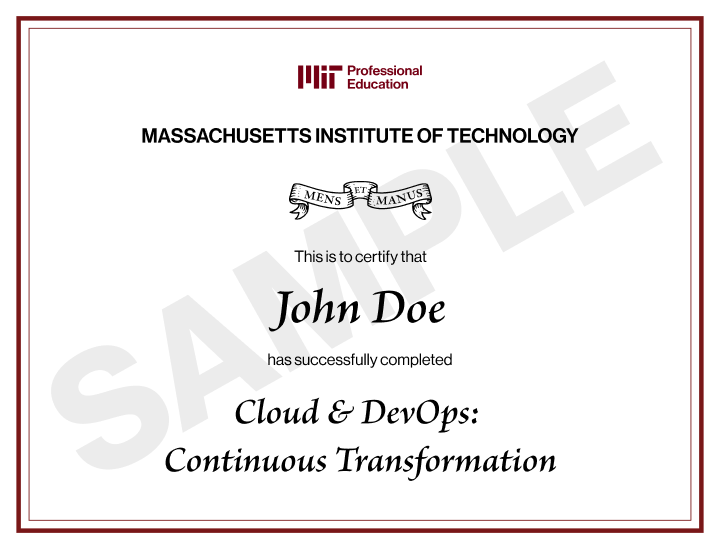
Certificate
All the participants who successfully complete their program will receive an MIT Professional Education Certificate of Completion, as well as Continuing Education Units (CEUs)*.
To obtain CEUs, complete the accreditation confirmation, which is available at the end of the course. CEUs are calculated for each course based on the number of learning hours.
*The Continuing Education Unit (CEU) is defined as 10 contact hours of ongoing learning to indicate the amount of time they have devoted to a non-credit/non-degree professional development program. To understand whether or not these CEUs may be applied toward professional certification, licensing requirements, or other required training or continuing education hours, please consult your training department or licensing authority directly.
Course outline
Intro to the Cloud: How We Got Here
Into the Cloud: The Story of How
Into the Cloud: The Story of How We Got to the Cloud
The Rise of the Internet and the World Wide Web
Web 2.0 and Going Mobile
Mobile and IoT: Everyone Generating Data
Cloud: The New Normal
Web Computing, Open-Source Software, and the Cloud
Computing Across Machines at Scale
The Browser − A Modern Data Portal
The Open-Source Movement
The Barriers to Entry Lower
Containers and Keys
What are Containers?
What is Docker?
How is Docker Used?
PKI and Keys
DevOps
What is DevOps?
What Does It Mean to Be Agile?
How DevOps Has Transformed Software
Implementing DevOps
Case Studies
Organizational Transformation and Stages of Adoption
Microsoft Testing in the Cloud
General Electric Case Study
Netflix Case Study
AWS Case Study − Move to the Cloud Recommendations
Architecting Software in the Cloud
The OODA Loop
Serverless
What is Serverless Computing?
'Going Serverless' - Pros and Cons
Function as a Service (FaaS): AWS Lambda
Serverless Security Setup Example
Writing a Serverless Lambda Function
Serverless Architecture for a BadBank
The Agile Corporation
The OODA Loop
What Does It Mean to Be an Agile Company?
The Traditional Corporation's Increasing Lack of Agility
How Can You Become Agile?
Unblocking Innovation for Digital Transformation
Stigmergy − Leave a Trail
Cloud Native
What is Cloud Native Computing?
What Is Kubernetes and How Is It Used?
Why Should You Care About Cloud Native Computing?
The Trail Map to Cloud Native
Who is this online course for?
CTOs, CINOs and leaders of technological departments or projects who need to understand the new possibilities that Cloud Computing offers for digital transformation and advancements in technical areas.
Technical professionals who want to obtain a broader strategic vision about how Cloud Computing and DevOps can transform their business operations.
CEOs, entrepreneurs and functional managers in technical areas or sectors who want to create new business models and upscale their current operations.
Instructors

Dr. Abel Sánchez
Research Scientist, MIT

Prof. John R. Williams
Professor, MIT Department of Civil and Environmental Engineering; Affiliated Faculty, MIT Center for Computational Science and Engineering.


MIT Professional Education in Numbers
+60K
+155
92%
Frequently Asked Questions
Are any taxes applicable to this program?
Applicable taxes will be calculated and added at checkout in accordance with country/state regulations.
Didn't find what you were looking for? Schedule a call with one of our Program Advisors or call us at +1 315 602 3089.
Register now and boost your professional trajectory.
Enroll by