


APPLIED AI BUNDLE
Generative and Agentic AI
Two AI Courses for Modern Business Transformation
Benefit From Up to 15% Off on This Bundle
As AI continues to reshape how organizations operate and compete, leaders must understand both the creative potential of generative AI and the execution capabilities of agentic AI. The Applied AI Bundle - Generative and Agentic AI brings together these complementary domains designed to help professionals move from experimentation to enterprise-wide transformation.

Highlights of the Bundle

Develop expertise across both Agentic AI and Generative AI through two complementary MIT Professional Education courses.

Engage in two live sessions with MIT instructors, and up to eight live sessions per course with learning facilitators, industry experts, and peers.

Networking opportunities establish professional connections with industry experts and your cohort.

Access to rich supplementary resources provides additional materials and content for a more thorough educational journey.

Earn a MIT Professional Education Certificate of Completion for each course successfully completed.
Courses You Will Take as a Bundle
1
Course 1: Applied AI for Digital Transformation
Module 1: Understanding AI and the Business Impact
The Evolution of AI: From Rule-based Systems to Machine Learning to Generative Models
What Makes Generative AI Distinct: Creating New Content Rather Than Predicting Outcomes
Why 2023–2025 Marked A Major Shift in AI Adoption and Business Impact
How AI Is Reshaping Key Sectors: Healthcare, Finance, Retail, Media, And Manufacturing
A Leadership-Focused Lens for Understanding and Evaluating AI
Setting Personal and Organizational Goals for Learning and Application
Module 2: How Generative AI Works
What Large Language Models Are, Explained Without Technical Jargon
How Inputs, Outputs, And Context Windows Shape Model Behavior
Why AI Hallucinations Occur and Their Impact on Organizational Use
How Tokens, Cost, And Model Size Affect Budgeting and Deployment Decisions
What Multimodal AI Enables Across Text, Images, Audio, And Code
How Leading Models Differ at a High Level and What Matters for Leadership Decisions
Key Warning Signs to Watch for When Evaluating AI Vendor Claims
Module 3: Prompt Engineering
What Prompt Engineering Is and Why It Matters
Core Techniques: Zero-shot, Few-shot, Chain-of-thought, Role Prompting
Prompting For Executive Tasks Such as Briefings, Strategy Memos, And Stakeholder Communication
Prompting For Team Tasks Including Documentation, Summaries, And Reporting
Automating Routine Workflows with Reusable Prompt Templates
Prompt Security and What to Avoid Sharing in Public AI Tools
Hands-on Practice to Build Your Personal Prompt Library
Module 4: AI Across the Organization
Marketing And CX: Personalization, Content Generation, Service Automation
Operations: Workflow Automation, Documentation, Procurement, Supply Chain
HR And Talent: Recruiting, Onboarding, Learning and Development, Performance
Finance: Reporting, Forecasting, Compliance Summarization
Product And Innovation: Ideation, Prototyping, Market Research
Leadership And Strategy: Competitive Intelligence, Board Communication, Scenario Planning
Case Studies: Klarna, Coca-Cola, JPMorgan and Others
Use-case Evaluation: Assessing Value, Risk and Organizational Readiness
Module 5: Ethics, Governance, and Responsible AI
The Ethics Landscape and What Is at Stake When AI Makes Decisions
Where Bias in AI Comes from and How Leaders Can Mitigate It
Privacy, Data Sovereignty, And Guidelines for Employee Use of AI Tools
When Transparency and Explainability Are Required for Auditable AI
The Regulatory Environment, Including the EU AI Act, U.S. Frameworks, And Sector Rules
How Responsible AI Frameworks from Google, Microsoft, And NIST Translate into Practice
Disinformation, Deepfakes, And Content Integrity Challenges
How To Begin Building an Internal AI Policy For Your Organization
Module 6: Building an AI-Ready Organization
What AI Readiness Means Across Technology, Data, People, And Culture
Common Failure Patterns in AI Adoption and How to Avoid Them
Communicating About AI Amid Uncertainty and Rapid Change
Upskilling Your Workforce and Identifying Essential Future Skills
Addressing AI-related Anxiety and Supporting Psychological Safety
Roles Of The CDO, CAIO, And AI Center Of Excellence
Applying Change-management Frameworks Such as Kotter and ADKAR To AI Initiatives
Building Internal AI Champions And Governance Structures
Module 7: The AI-Enabled Economy - Workforce, Disruption, and Opportunity
The Economic Impact of Generative AI Across Productivity, Displacement, And New Value Creation
Which Jobs and Tasks Are Most Exposed to Automation, And Which Remain Resilient
AI Augmentation Versus Replacement and How Leaders Can Apply This Distinction
How AI Is Reshaping Competitive Dynamics Through First-mover Advantage and Differentiation
What AI-native Competitors Reveal and What Incumbents Can Learn from Them
Global AI Investment Trends and Their Implications for Sector Strategy
How Leadership Is Evolving and Which Human Capabilities Grow in Importance
Module 8: Creating An AI Strategy
Reviewing The Strategic AI Framework and Bringing All Concepts Together
Using The AI Opportunity Canvas to Map Use Cases to Business Value
Applying An Effort-impact-risk Matrix to Prioritize AI Initiatives
Building An AI Roadmap Across Quick Wins, Mid-term Initiatives, And Long-term Transformation
Crafting The Business Case for AI Investment and Making the Ask Effectively
Presenting Your AI Strategy to Boards, Investors, And Skeptical Stakeholders
Capstone Workshop to Develop and Peer-review Your Organizational AI Strategy
Final Reflection on the Kind of AI Leader You Aim to Become
Capstone Project The course includes a capstone project where learners synthesize concepts from all modules into an actionable AI strategy for their organization. Participants develop a prioritized opportunity map, build an adoption roadmap with owners and timelines, and outline key risks, dependencies, and success metrics. The capstone ensures that every learner leaves with a concrete, organization-ready plan that translates learning into practical, strategic action.
2
Course 2: Applied Agentic AI for Organizational Transformation
Module 1: Foundations of Generative and Agentic AI
Evaluate the strategic value of AI functionalities such as chatbots, reasoning, and multimedia
Construct an evaluation of the cost of an AI system
Distinguish between major AI model types and terminology
Module 2: The Rise of Agentic AI and Emerging AI Platforms
Explain the most relevant AI platform or approach for a specific sector and its application to agentic AI use cases
Evaluate the key factors influencing the selection of open-source versus proprietary AI platforms within a specific organizational context
Develop a landing page using AI
Prompt AI to create a visual mock-up and functional HTML code
Activate the code by saving and reuploading
Explain a new AI workflow in an organization
Module 3: Connecting Agents to Digital Ecosystems
Construct a use case demonstrating agent-based interaction across integrated tools
Write a structured email-style proposal that outlines a specific use case for an AI agent within an organizational context
Analyze a business workflow to determine how an AI agent could improve efficiency, reduce costs, or enhance user experience
Design an integration approach that specifies how the proposed agent would connect with existing systems, platforms, or application programming interfaces (APIs)
Evaluate the potential risks, ethical considerations, and success metrics associated with deploying the proposed AI agent
Module 4: Cybersecurity: Classic Scenarios, Agent Risks, Disinformation, and Systemic Impact
Analyze organizational AI systems and workflows to identify potential cybersecurity risks using the National Institute of Standards and Technology (NIST) Cybersecurity Framework categories
Evaluate current security practices to identify gaps in access control, monitoring, response, and recovery capabilities
Develop a structured AI risk and security plan, including stakeholders, training, and incident response procedures
Recommend actions to improve organizational readiness across identify, protect, detect, respond, and recover domains
Analyze organizational AI systems and workflows to identify potential cybersecurity risks
Evaluate how accountability is defined and enforced alongside security practices and governance in AI systems
Module 5: AI Agents by Business Function
Describe the organizational context, including industry, organization type, and department, relevant to a proposed AI-driven product design initiative
Summarize the current product design workflow within an organization to establish a baseline for improvement
Select an appropriate AI technology for integration into a product design process based on its capabilities and relevance
Develop a structured plan outlining how AI can be integrated into a product design workflow to improve efficiency, effectiveness, or quality
Identify an appropriate AI agent architecture for a given organizational context and explain key trade-offs
Identify opportunities for AI-enabled BPO and describe their potential organizational impact
Module 6: The Last Mile- From Pilot to Practice
Propose measurable key performance indicators (KPIs) that evaluate the effectiveness of an AI system in relation to business outcomes.
Describe the organizational context including sector, organization type, and department relevant to an AI implementation
Summarize the purpose and functionality of a proposed AI system within a business workflow
Write three to five key performance indicators (KPIs) that measure the effectiveness of an AI implementation
Evaluate how the selected KPIs align with business goals, and indicate whether the AI system is achieving its intended outcomes
Module 7: Governance, Compliance, and Agent Testing
Identify applicable regulatory frameworks (e.g., GDPR, CCPA, HIPAA) relevant to a specific AI use case
Analyze the risks associated with deploying AI systems, including both compliance and operational risks
Apply appropriate testing strategies (e.g., sandboxing, A/B testing, safety checks) to evaluate AI system behavior
Develop a comprehensive AI governance plan that integrates regulations, testing, risk mitigation, and documentation practices
Create guiding questions that identify key regulatory and implementation considerations in real-world AI healthcare scenarios
Classify AI use cases using the risk–speed quadrant framework
Module 8: Ethics and Capstone
Explain how AI can be strategically integrated into organizational functions to create business value
Evaluate the suitability of AI technologies for specific organizational use cases
Analyze the cost, security, and operational implications of AI adoption
Assess the human and organizational factors that influence successful AI implementation
Synthesize course concepts into a structured approach for organizational AI adoption
Evaluate ethical risks in a proposed AI system by identifying a potential issue, assessing its business impact, and recommending an appropriate mitigation strategy
Capstone Project The course culminates in a capstone project where participants apply course concepts to evaluate an organizational AI opportunity. They will assess the suitability of AI technologies for a specific use case, analyze the associated business, operational, security, and ethical considerations, and develop a structured approach for responsible AI adoption. The final deliverable includes recommendations for implementation, risk mitigation, and value creation within an organizational context.
Gain Experience With Popular AI Tools
Disclaimer: All product and company names are trademarks or registered trademarks of their respective holders. Use of product and company names does not imply any affiliation with or endorsed by MIT Professional Education
Who Is This Bundle For?
This bundle is ideal for:
C-suite executives and senior leaders making informed decisions on AI strategy, investment, and integration
Business leaders and functional heads driving innovation across operations, marketing, product, and strategy
Senior and mid-career professionals seeking to apply AI across workflows, functions, and organizational initiatives
Technology leaders and technical professionals transitioning into AI and digital transformation leadership roles
Managers and team lead modernizing workflows and aligning teams with emerging technologies
Innovation, product, sales, marketing, and customer experience professionals leveraging AI to build new solutions and enhance engagement
Consultants, advisors, and investors evaluating AI opportunities and guiding organizations through AI-driven change
*No prior background in analytics, computer science, coding, or machine learning is required.
Instructors

Dr. Abel Sanchez
Research Scientist, MIT

Prof. John R. Williams
Professor, MIT Department of Civil and Environmental Engineering; Affiliated Faculty, MIT Center for Computational Science and Engineering
Certificate
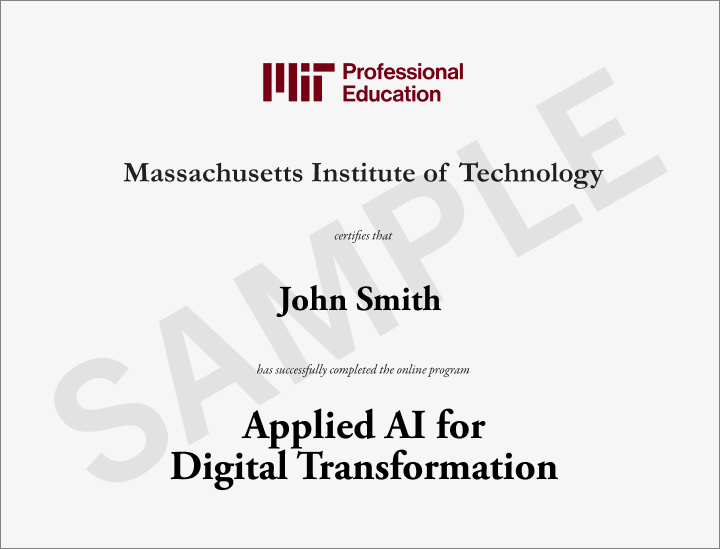
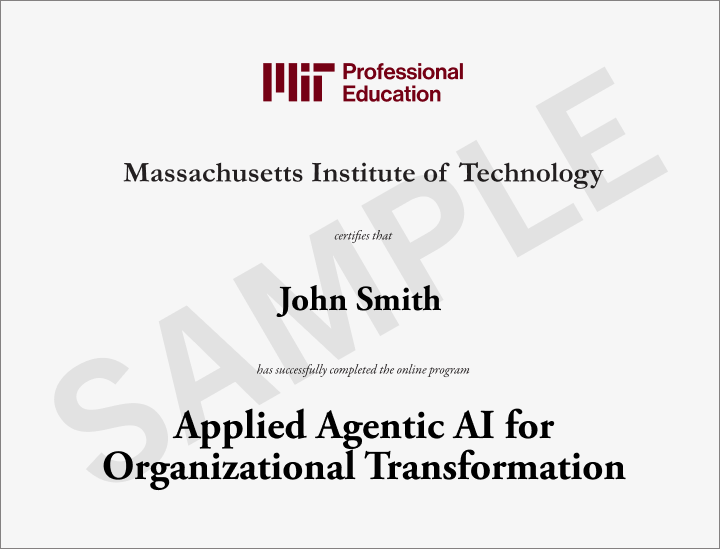
All participants who successfully complete the Applied AI Bundle - Generative and Agentic AI will receive two MIT Professional Education Certificates of Completion, one for completion of each course, Applied AI for Digital Transformation and Applied Agentic AI for Organizational Transformation. Participants will also earn MIT Continuing Education Units (MIT CEUs) for each completed course.*
*To obtain MIT CEUs, participants must complete the accreditation confirmation available at the end of each course. MIT CEUs are awarded based on the number of learning hours, where one MIT CEU represents 10 contact hours of participation in a professional development program.
MIT Professional Education in Numbers
+60K
Participants in our courses
+155
Countries represented by our participants
92%
Rate the experience as extraordinary
Frequently Asked Questions
1
Do I need prior experience in AI or programming?
No prior background in analytics, computer science, coding, or machine learning is required. Both courses are designed for professionals who may not build AI systems themselves but are responsible for evaluating, adopting, and leading AI initiatives within their organizations.
2
What will I gain from completing this bundle?
You will gain the ability to understand, apply, and scale AI across your organization. This includes evaluating AI opportunities, designing AI-integrated strategies, and developing an executive-ready AI adoption roadmap or presentation supported by real-world use cases and hands-on learning.
3
How is this bundle different from taking a single AI course?
This bundle provides a comprehensive learning journey across both generative and agentic AI. While one course focuses on understanding AI capabilities and business applications, the other focuses on deploying AI systems, integrating them into workflows, and driving real organizational impact.
4
Will I work on real-world applications or projects?
Yes. This bundle includes hands-on projects and real-world applications. You will apply your learning through exercises and capstone projects where you build an AI strategy, adoption roadmap, or executive presentation tailored to your organization.
5
Are any taxes applicable to this bundle?
Applicable taxes will be calculated and added at checkout in accordance with country/state regulations.
6
How will this bundle help me in my role?
This bundle equips you to translate AI from concept to execution. You will learn how to assess business value, integrate AI into existing systems, manage risks and governance, and communicate AI strategies effectively to stakeholders across your organization.
Connect with a Program Advisor for a 1:1 Session
Didn't find what you were looking for? Schedule a call with one of our Program Advisors or call us at +1 857 7668188.
Register now and boost your professional trajectory.
Enroll by