


AI and Leadership Bundle
Applied Agentic AI and AI-Driven Leadership
Benefit From Up to 15% Off on This Bundle
As agentic AI creates new opportunities to improve workflows, leaders must understand both its practical applications and the organizational change required for adoption. The AI and Leadership Bundle - Applied Agentic AI and AI-Driven Leadership brings together two individual, complementary online courses at a bundled price. Together, they help participants move from identifying AI opportunities to planning responsible implementation, aligning people, processes, technology, and business goals.

Highlights of the Bundle

Develop expertise across Agentic AI and AI leadership through two complementary MIT Professional Education courses.

Engage in two live sessions with MIT instructors and up to eight office hour sessions with learning facilitators per course, alongside industry experts and peers.

Networking opportunities establish professional connections with industry experts and your cohort.

Access to rich supplementary resources provides additional materials and content for a more thorough educational journey.

Earn a MIT Professional Education Certificate of Completion for each course successfully completed.
Courses in the Bundle
1
Course 1: Applied Agentic AI for Organizational Transformation
Online | 8 Weeks
Module 1: Foundations of Generative and Agentic AI
Evaluate the strategic value of AI functionalities such as chatbots, reasoning, and multimedia
Construct an evaluation of the cost of an AI system
Distinguish between major AI model types and terminology
Module 2: The Rise of Agentic AI and Emerging AI Platforms
Explain the most relevant AI platform or approach for a specific sector and its application to agentic AI use cases
Evaluate the key factors influencing the selection of open-source versus proprietary AI platforms within a specific organizational context
Develop a landing page using AI
Prompt AI to create a visual mock-up and functional HTML code
Activate the code by saving and reuploading
Explain a new AI workflow in an organization
Module 3: Connecting Agents to Digital Ecosystems
Construct a use case demonstrating agent-based interaction across integrated tools
Write a structured email-style proposal that outlines a specific use case for an AI agent within an organizational context
Analyze a business workflow to determine how an AI agent could improve efficiency, reduce costs, or enhance user experience
Design an integration approach that specifies how the proposed agent would connect with existing systems, platforms, or application programming interfaces (APIs)
Evaluate the potential risks, ethical considerations, and success metrics associated with deploying the proposed AI agent
Module 4: Cybersecurity: Classic Scenarios, Agent Risks, Disinformation, and Systemic Impact
Analyze organizational AI systems and workflows to identify potential cybersecurity risks using the National Institute of Standards and Technology (NIST) Cybersecurity Framework categories
Evaluate current security practices to identify gaps in access control, monitoring, response, and recovery capabilities
Develop a structured AI risk and security plan, including stakeholders, training, and incident response procedures
Recommend actions to improve organizational readiness across identify, protect, detect, respond, and recover domains
Evaluate how accountability is defined and enforced alongside security practices and governance in AI systems
Module 5: AI Agents by Business Function
Describe the organizational context, including industry, organization type, and department, relevant to a proposed AI-driven product design initiative
Summarize the current product design workflow within an organization to establish a baseline for improvement
Select an appropriate AI technology for integration into a product design process based on its capabilities and relevance
Develop a structured plan outlining how AI can be integrated into a product design workflow to improve efficiency, effectiveness, or quality
Identify an appropriate AI agent architecture for a given organizational context and explain key trade-offs
Identify opportunities for AI-enabled BPO and describe their potential organizational impact
Module 6: The Last Mile - From Pilot to Practice
Propose measurable key performance indicators (KPIs) that evaluate the effectiveness of an AI system in relation to business outcomes
Describe the organizational context including sector, organization type, and department relevant to an AI implementation
Summarize the purpose and functionality of a proposed AI system within a business workflow
Write three to five key performance indicators (KPIs) that measure the effectiveness of an AI Implementation
Evaluate how the selected KPIs align with business goals, and indicate whether the AI system is achieving its intended outcomes
Module 7: Governance, Compliance, and Agent Testing
Identify applicable regulatory frameworks (e.g., GDPR, CCPA, HIPAA) relevant to a specific AI use case
Analyze the risks associated with deploying AI systems, including both compliance and operational risks
Apply appropriate testing strategies (e.g., sandboxing, A/B testing, safety checks) to evaluate AI system behavior
Develop a comprehensive AI governance plan that integrates regulations, testing, risk mitigation, and documentation practices
Create guiding questions that identify key regulatory and implementation considerations in real-world AI healthcare scenarios
Classify AI use cases using the risk–speed quadrant framework
Module 8: Ethics and Capstone
Explain how AI can be strategically integrated into organizational functions to create business value
Evaluate the suitability of AI technologies for specific organizational use cases
Analyze the cost, security, and operational implications of AI adoption
Assess the human and organizational factors that influence successful AI implementation
Synthesize course concepts into a structured approach for organizational AI adoption
Evaluate ethical risks in a proposed AI system by identifying a potential issue, assessing its business impact, and recommending an appropriate mitigation strategy
Capstone Project
The course culminates in a capstone project where participants develop a structured AI adoption plan or executive presentation for their organization. They apply course concepts to identify an AI opportunity, evaluate its suitability and implementation considerations, and recommend an approach to responsible adoption. Hands-on assessments and expert guidance from MIT instructors support the project.
2
Course 2: AI-Driven Leadership
Online | 8 Weeks
Module 1: The New Era of Digital Transformation
Identify the key capabilities necessary for thriving in a digitally powered business environment
Analyze the role of technology in driving organizational transformation across various industries
Explore examples of successful digital transformation in sectors like healthcare, finance, and manufacturing
Module 2: Making Sense of Artificial Intelligence
Identify the limitations, risks, and cost-benefit trade-offs associated with different AI models and algorithms
Apply the “Gen AI Cost Equation” to identify business scenarios where the use of generative AI can drive productivity
Develop a structured approach to evaluating AI tools, formulating the right questions to assess their feasibility, risks, and business impact
Module 3: Living and Working With Non-Human Collaborators
Assess the current capabilities of robots and autonomous systems in both hardware and software forms
Analyze the implications of human-machine collaboration for the future of work
Module 4: Driving Transformational Change
Analyze the key leadership capabilities of digital mastery
Identify the key components of a compelling vision
Utilize the “three lenses” framework to engage stakeholders in digital transformation initiatives
Outline a robust governance strategy to drive coordination across AI, digital, and other activities
Examine methods to engage employees in making the vision a reality
Module 5: Thriving in Webs of Connectivity: The Internet of Things and Digital Threads
Understand the principles of IoT and digital threads in creating interconnected business environments
Evaluate how real-time data can be used to diagnose issues and personalize solutions
Module 6: Building the Capability to Thrive
Evaluate the key components of a digital and AI-ready culture for your organization
Understand how to improve the strategic integration between technology and business leaders
Consider examples of assumptions that may underlie organizational culture and challenge them when they hinder digital transformation
Module 7: Peeking over the Technology Horizon
Explore the abilities and current limits of emerging technologies
Evaluate the potential for these technologies to drive future business innovation
Forecast adoption and integration timelines for emerging technologies
Module 8: Co-creating the Future
Explore strategies organizations can take toward preparing for an AI-powered future
Evaluate your organization’s readiness to support ongoing learning, training, and internal mobility
Apply guiding notions of digital transformation to assess and strengthen organizational readiness
Develop a roadmap for implementing a transformative digital innovation within your organization
*Curriculum and course modules are subject to change.
Who Is This Bundle For?
The AI and Leadership Bundle - Applied Agentic AI and AI-Driven Leadership is designed for mid- to senior-level professionals responsible for evaluating technology opportunities, leading digital transformation, or choosing, funding, governing, and operationalizing AI initiatives. Professionals who may benefit include:
C-suite executives, business executives, and senior leaders responsible for strategic planning, decision-making, and assessing how AI, IoT, and robotics affect their organizations and industries
Business leaders and functional heads driving digital innovation across operations, strategy, marketing, and product
Managers and team leads modernizing workflows and aligning teams with technology change
Technology leaders, IT professionals, and technical professionals connecting emerging technologies with business objectives and bridging engineering and transformation leadership
Change management and transformation leaders developing adoption strategies and cultivating a digitally ready organizational culture
Entrepreneurs and innovators applying advanced technologies to improve products and services, explore market opportunities, and respond to emerging trends
Consultants and advisors guiding clients through digital transformation, technology adoption, and organizational change
Mid- to senior-level professionals across industries, including healthcare, finance, manufacturing, mining, and other sectors undergoing significant digital disruption
*No prior background in analytics, computer science, coding, or machine learning is required.
Instructors

Dr. Brian Anthony
Principal Research Scientist, MIT Mechanical Engineering | Associate Principal Research Scientist, MIT Institute of Medical Engineering & Science | Director, Master of Engineering in Manufacturing Program | Associate Director, MIT.nano

Prof. Rama Ramakrishnan
Professor of the Practice at the MIT Sloan School of Management

Dr. Abel Sanchez
Research Scientist, MIT

Dr. George Westerman
Senior Lecturer and Principal Research Scientist, MIT Sloan School of Management

Prof. John R. Williams
Professor, MIT Department of Civil and Environmental Engineering; Affiliated Faculty, MIT Center for Computational Science and Engineering.
Certificate
Participants who successfully complete both courses in the AI and Leadership Bundle - Applied Agentic AI and AI-Driven Leadership will receive two MIT Professional Education Certificates of Completion, one for AI-Driven Leadership and one for Applied Agentic AI for Organizational Transformation. Participants will also earn MIT Continuing Education Units (MIT CEUs) for each completed course. *
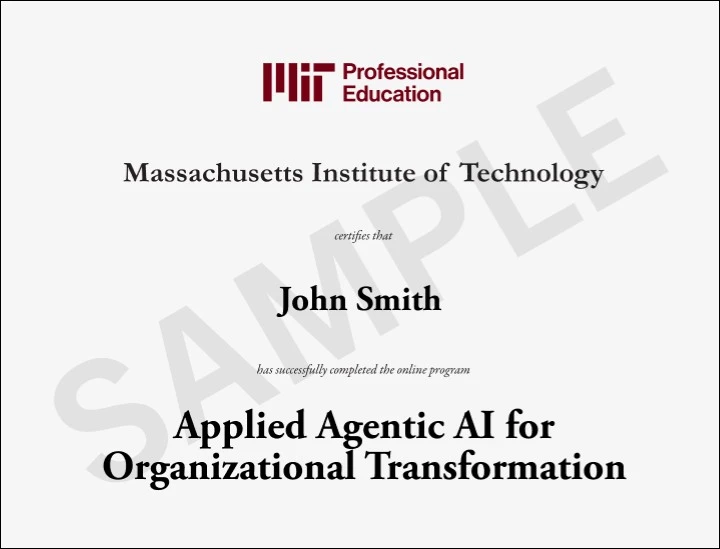
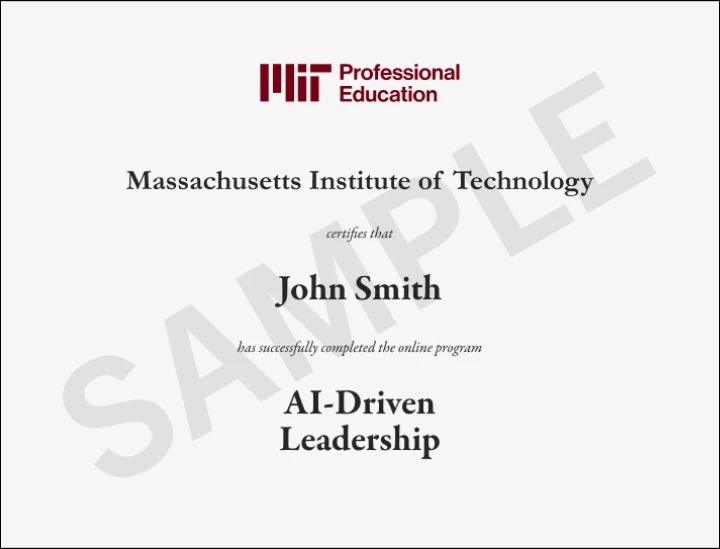
*To obtain MIT CEUs, participants must complete the accreditation confirmation available at the end of each course. MIT CEUs are awarded based on the number of learning hours, where one MIT CEU represents 10 contact hours of participation in a professional development program.
Frequently Asked Questions
1
Do I need prior experience in AI or programming?
No prior background in analytics, computer science, coding, or machine learning is required.
2
What will I gain from completing this bundle?
Together, the courses help participants progress from identifying a promising AI opportunity to planning its responsible implementation, with business goals, people, processes, technology, and risk considered throughout.
3
How is this bundle different from taking a single AI course?
The AI and Leadership Bundle - Applied Agentic AI and AI-Driven Leadership from MIT Professional Education offers two individual, complementary online courses, each eight weeks, at a bundled price. Together, the courses help participants progress from identifying a promising AI opportunity to planning its responsible implementation, with business goals, people, processes, technology, and risk considered throughout.
4
Will I work on real-world applications or projects?
Applied Agentic AI for Organizational Transformation course culminates in a capstone project where participants develop a structured AI adoption plan or executive presentation for their organization. They apply course concepts to identify an AI opportunity, evaluate its suitability and implementation considerations, and recommend an approach to responsible adoption. Hands-on assessments and expert guidance from MIT instructors support the project.
5
How will this bundle help me in my role?
Analyze business workflows to identify where AI agents could improve efficiency, reduce costs, or enhance user experience. Evaluate the suitability and cost of proposed AI applications. Examine the culture, skills, and systems required for transformation. Identify adoption barriers and develop strategies for embedding technology into business operations.
6
Are any taxes applicable to this bundle?
Applicable taxes will be calculated and added at checkout in accordance with country/state regulations.
Connect with a Program Advisor for a 1:1 Session
Didn't find what you were looking for? Schedule a call with one of our Program Advisors or call us at +1 857 7668188.
Please note that our team is away from December 22, 2026 to January 5, 2027 for the year-end holidays. We look forward to addressing your queries when we resume operations in the new year.
Register now and boost your professional trajectory.
Enroll by