

ONLINE COURSE
Applied Agentic AI for Organizational Transformation
Leverage AI Agents to Elevate Efficiency and Innovate Models
What you will learn?
Understand the fundamentals of generative and agentic AI, including their architectures, use cases, and future potential
Assess where and how AI can improve business outcomes, from operational workflows to customer engagement, while evaluating the viability and cost-effectiveness of AI adoption
Integrate AI systems into existing digital ecosystems, leveraging cloud infrastructure, APIs, and enterprise platforms
Evaluate AI platforms for strategic fit, capabilities, business value, and risk
Develop agent-based solutions to orchestrate multistep workflows and enhance automation
Navigate governance and compliance challenges, including ethical deployment and regulatory frameworks like GDPR, HIPAA, and CCPA.
Build a strategic AI roadmap, culminating in an actionable adoption plan or executive pitch, supported by change management considerations for successful implementation.
Why enroll in this course?

Engage in two live sessions with MIT instructors, and up to eight live sessions with learning facilitators, industry experts, and peers.

Networking opportunities establish professional connections with industry experts and your cohort.

Access to rich supplementary resources provides additional materials and content for a more thorough educational journey.

Navigate AI’s ethical and regulatory landscape with confidence, from bias and data privacy to frameworks like GDPR, CCPA, and HIPAA.

Join a global network of peers and professionals engaged in reimagining how AI drives impact at scale.

Bridge the gap between AI and business outcomes, without needing a technical background.
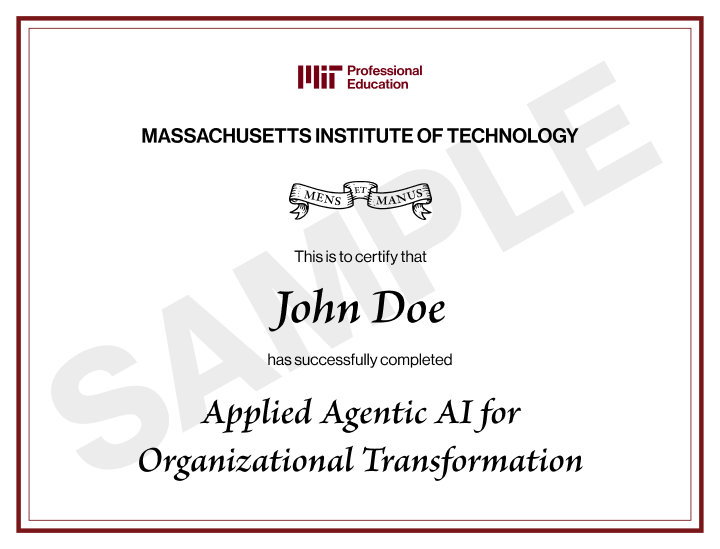
Certificate
All the participants who successfully complete their program will receive an MIT Professional Education Certificate of Completion, as well as Continuing Education Units (CEUs)*.
To obtain CEUs, complete the accreditation confirmation, which is available at the end of the course. CEUs are calculated for each course based on the number of learning hours.
*The Continuing Education Unit (CEU) is defined as 10 contact hours of ongoing learning to indicate the amount of time they have devoted to a non-credit/non-degree professional development program.
To understand whether or not these CEUs may be applied toward professional certification, licensing requirements, or other required training or continuing education hours, please consult your training department or licensing authority directly.
Modules
Foundations of Generative and Agentic AI
Evaluate the Strategic Value of AI Functionalities Such as Chatbots, Reasoning, and Multimedia
Construct an Evaluation of the Cost of an AI System
Distinguish Between Major AI Model Types and Terminology
The Rise of Agentic AI and Emerging AI Platforms
Explain the Most Relevant AI Platform or Approach for a Specific Sector and Its Application to Agentic AI Use Cases
Evaluate the Key Factors Influencing the Selection of Open-Source Versus Proprietary AI Platforms Within a Specific Organizational Context
Develop a Landing Page Using AI
Prompt AI to Create a Visual Mock-Up and Functional HTML Code
Activate the Code by Saving and Reuploading It
Explain a New AI Workflow Within an Organization
Connecting Agents to Digital Ecosystems
Construct a Use Case Demonstrating Agent-Based Interaction Across Integrated Tools
Write a Structured Email-Style Proposal That Outlines a Specific Use Case for an AI Agent Within an Organizational Context
Analyze a Business Workflow to Determine How an AI Agent Could Improve Efficiency, Reduce Costs, or Enhance User Experience
Design an Integration Approach That Specifies How the Proposed Agent Would Connect With Existing Systems, Platforms, or Application Programming Interfaces (APIs)
Evaluate the Potential Risks, Ethical Considerations, and Success Metrics Associated With Deploying the Proposed AI Agent
Cybersecurity: Classic Scenarios, Agent Risks, Disinformation, and Systemic
Analyze Organizational AI Systems and Workflows to Identify Potential Cybersecurity Risks Using the National Institute of Standards and Technology (NIST) Cybersecurity Framework Categories
Evaluate Current Security Practices to Identify Gaps in Access Control, Monitoring, Response, and Recovery Capabilities
Develop a Structured AI Risk and Security Plan, Including Stakeholders, Training, and Incident Response Procedures
Recommend Actions to Improve Organizational Readiness Across Identify, Protect, Detect, Respond, and Recover Domains
Analyze Organizational AI Systems and Workflows to Identify Potential Cybersecurity Risks
Evaluate How Accountability Is Defined and Enforced Alongside Security Practices and Governance in AI
AI Agents by Business Function
Describe the Organizational Context, Including Industry, Organization Type, and Department, Relevant to a Proposed AI-Driven Product Design Initiative
Summarize the Current Product Design Workflow Within an Organization to Establish a Baseline for Improvement
Select an Appropriate AI Technology for Integration Into a Product Design Process Based on Its Capabilities and Relevance
Develop a Structured Plan Outlining How AI Can Be Integrated Into a Product Design Workflow to Improve Efficiency, Effectiveness, or Quality
Identify an Appropriate AI Agent Architecture for a Given Organizational Context and Explain Key Trade-Offs
Identify Opportunities for AI-Enabled BPO and Describe Their Potential Organizational Impact
The Last Mile – From Pilot to Practice
Propose Measurable Key Performance Indicators (KPIs) That Evaluate the Effectiveness of an AI System in Relation to Business Outcomes
Describe the Organizational Context, Including Sector, Organization Type, and Department, Relevant to an AI Implementation
Summarize the Purpose and Functionality of a Proposed AI System Within a Business Workflow
Write Three to Five Key Performance Indicators (KPIs) That Measure the Effectiveness of an AI Implementation
Evaluate How the Selected KPIs Align With Business Goals and Indicate Whether the AI System Is Achieving Its Intended Outcomes
Governance, Compliance, and Agent Testing
Identify Applicable Regulatory Frameworks (e.g., GDPR, CCPA, HIPAA) Relevant to a Specific AI Use Case
Analyze the Risks Associated With Deploying AI Systems, Including Both Compliance and Operational Risks
Apply Appropriate Testing Strategies (e.g., Sandboxing, A/B Testing, Safety Checks) to Evaluate AI System Behavior
Develop a Comprehensive AI Governance Plan That Integrates Regulations, Testing, Risk Mitigation, and Documentation Practices
Create Guiding Questions That Identify Key Regulatory and Implementation Considerations in Real-World AI Healthcare Scenarios
Classify AI Use Cases Using the Risk–Speed Quadrant Framework
Ethics and Capstone
Explain How AI Can Be Strategically Integrated Into Organizational Functions to Create Business Value
Evaluate the Suitability of AI Technologies for Specific Organizational Use Cases
Analyze the Cost, Security, and Operational Implications of AI Adoption
Assess the Human and Organizational Factors That Influence Successful AI Implementation
Synthesize Course Concepts Into a Structured Approach for Organizational AI Adoption
Evaluate Ethical Risks in a Proposed AI System by Identifying a Potential Issue, Assessing Its Business Impact, and Recommending an Appropriate Mitigation Strategy
*Modules and curriculum are subject to change
Capstone Project
Apply your learning in a final capstone project designed to demonstrate real-world impact. Choose between two strategic paths:
Design a comprehensive AI integration plan tailored to a specific business function, or
Develop an executive presentation that outlines a transformative, agent-based AI initiative.
Support your project with a detailed risk-benefit analysis, cost implications, and measurable KPIs to demonstrate strategic value.
Who is the course for?
This program is designed for mid-to-senior working professionals who understand the urgency of AI and want to lead its adoption effectively across their organizations. Whether you're shaping digital strategy, managing transformation initiatives, or advising others on innovation, this course gives you the frameworks to turn AI into actionable outcomes. This program is ideal for:
C-suite executives (CEOs, CIOs, CTOs, CMOs, COOs) aiming to make informed decisions about AI strategy and integration
Business leaders and function heads driving digital innovation in operations, marketing, product, or strategy
Managers and team leads modernizing workflows and aligning cross-functional teams with emerging technologies
Technical professionals moving into leadership roles in digital transformation or innovation
Consultants and advisors supporting clients through AI-driven change and adoption planning
Prerequisites: No prior background in analytics, computer science, coding or machine learning is required.
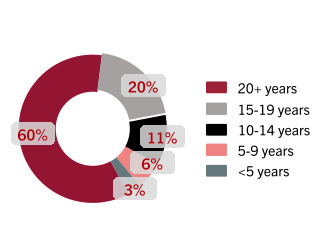
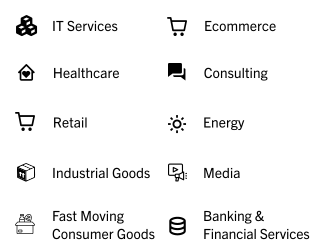
Past Participants Profile
Work Experience
Top Industries
Top Countries

Instructors

DR. ABEL SANCHEZ
Research Scientist, MIT

PROF. JOHN R. WILLIAMS
Professor, MIT Department of Civil and Environmental Engineering; Affiliated Faculty, MIT Center for Computational Science and Engineering.
MIT Professional Education in Numbers
+60K
+155
92%
Frequently Asked Questions
Are any taxes applicable to this program?
Applicable taxes will be calculated and added at checkout in accordance with country/state regulations.
Connect with a Program Advisor for a 1:1 Session
Didn't find what you were looking for? Schedule a call with one of our Program Advisors or call us at +1 315 602 3089.
Register now and boost your professional trajectory.
Enroll by